The Tesla Roadster's long-awaited launch has a new date of October 1, 2026, promising extraordinary acceleration with SpaceX rocket technology.
The highly anticipated launch of Tesla's second-generation Roadster has seen more twists than a rollercoaster, experiencing years of delays since its revelation almost a decade ago. Initially announced in 2017 with promises of production commencing in 2020, CEO Elon Musk has now rescheduled its debut to October 1, 2026. Will this date finally stick?
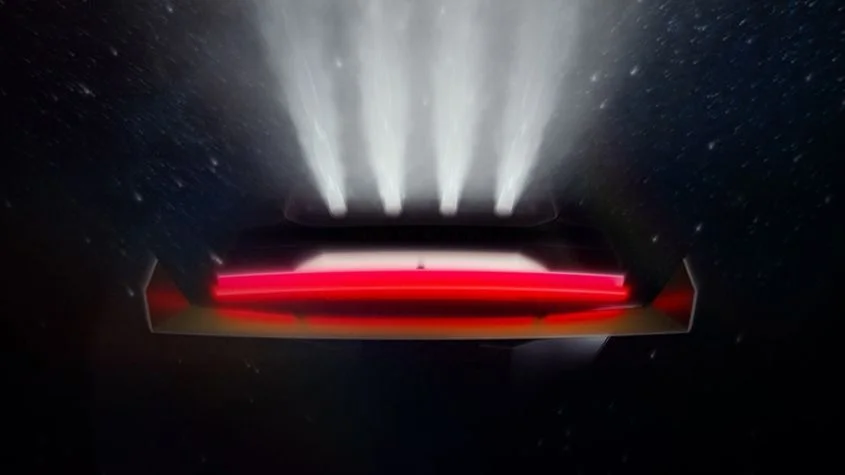
Details are scant ahead of the event, but an abstract teaser image has emerged alongside a countdown timer culminating on October 2 at 0130 BST. Musk confirmed that Tesla will officially 'unveil' the vehicle on the stipulated date. The teaser image hints at a dramatic redesign compared to the 2017 model, showcasing an aggressive new diffuser and an expansive lightbar.
In his last update regarding the Roadster in 2024, Musk revealed that Tesla had significantly escalated the vehicle's design ambitions, suggesting it might not even be regarded as a conventional car. Continuing a conversation from 2018, he mentioned collaboration with SpaceX for the integration of gas thrusters, with the aim of achieving a phenomenal sub-1 second 0-60 mph acceleration time.
The teaser’s rear design appears to feature four cold gas thrusters, further supporting the speculation of a SpaceX collaboration. Its caption, 'go for launch', reinforces the impression that the use of aerospace technology is still part of the plan.
In discussions surrounding this rocket-derived technology, Mate Rimac, CEO of Bugatti-Rimac, acknowledged the viability of using thrusters but highlighted the challenges of sustaining such systems, including the potential dead weight from tanks and compressors. He also noted that while extreme acceleration is feasible, drawbacks persist with the overall weight dynamics in regular supercars. Rimac ultimately suggested that thrusters might be essential, despite their limitations.
Since the 2017 unveiling, the Roadster has faced numerous hurdles attributed to global events and supply chain issues. Musk indicated that production wouldn’t commence until Tesla reached specific milestones, including the completion of its Berlin Gigafactory and ramping up production of the Model Y. With those objectives now accomplished, the pathway seems clearer.
The original Roadster was Tesla's entry into the market, leveraging a modified Lotus Elise chassis, while the upcoming model aims for a far grander ambition. Though exact power figures remain unreported, Tesla has thrown around some impressive statistics. The stated torque figure of 7,300 lb-ft is a 'wheel torque' measure, necessitating caution as it can mislead compared to other manufacturers’ outputs.
The new Roadster promises all-wheel drive delivering its power instantly, and it's expected to weigh less than the Model S, X, and 3, particularly given its claimed acceleration capability. The previous quarter-mile performance forecasted was just 8.8 seconds, attributed to the advanced 'Plaid' powertrain featuring three motors instead of two, and a new high-capacity battery.
In a departure from many electric models, Tesla assures exceptional top speed won't compromise the Roadster's range. The vehicle is projected to exceed 250 mph, but driving at normal speeds may yield a 620-mile range thanks to its 200 kWh battery pack.
Though the teaser presents a vision of what to expect, the actual production model may differ significantly. Confusion about the Roadster designation arises considering its coupe aesthetic, but clarity comes with the removal of the central targa-style panel.
The interior is designed to seat four in a minimalist Tesla fashion. It features a conventional dashboard layout but incorporates an aircraft-style yoke steering wheel, which has sparked debate since its introduction in the Model S Plaid.
Since the unveiling, Tesla has accepted a $50,000 deposit for the standard $200,000 Roadster, with a premium Founder Series model demanding a $250,000 full-price deposit.
As excitement builds for the October 2026 unveiling, enthusiasts and industry watchers alike will be eager to see if the new Roadster can live up to both its promises and its past delays.
Discussion
Sign in to join the discussion.