During the 1980s, several audacious supercar concepts emerged but never reached production. Here's a look at those remarkable yet unrealized designs.
The 1980s witnessed a flurry of dazzling supercar concepts that, despite their potential, remained unlikely participants in the automotive marketplace. Among the most notable was the Aston Martin Bulldog, introduced early in the decade. With its striking wedge shape, enormous gullwing doors, and a powerful twin-turbo V8 engine, it set the tone for the burgeoning decade—albeit as a belated nod to '70s styling. The Bulldog was not just a car; it was a bold statement that challenged the conventional ideals of luxury and performance, showcasing an era more focused on eye-catching aesthetics than practical market viability.
Peugeot's Daring Quasar
In 1984 at the Paris Motor Show, Peugeot unveiled the Quasar, a bold and imposing design reflecting the decade's flair. Its aggressive stance was complemented by a spacious cockpit-style cabin and eccentric doors, creating a vehicle that stood out in a crowd, even among other ambitious designs. Under the hood, it housed a turbocharged 1.8-liter engine sourced from the famed 205 T16 rally car, making its technical showcase almost as captivating as its design. Peugeot's commitment to bridging performance and avant-garde design with the Quasar was a reflection of a company in transition during a pivotal time in its history, signaling an ambition that would come to underline its later successes in motorsport and commercial vehicles alike.
Honda's HP-X Concept
Similarly surprising was Honda’s HP-X concept, also unveiled in 1984 in collaboration with Pininfarina. This audacious design featured a low profile, a unique canopy roof, and a motorsport engine—a 2-liter V6 derived from Formula 2 racing. The striking white and red color scheme epitomized the 1980s aesthetic, although the car’s unorthodox design made it too radical for consumers. Honda's HP-X represented a powerful intersection of racing pedigree and consumer ambition, hinting at the eventual development of the NSX, which would redefine the supercar genre by combining performance with everyday usability. Its forward-thinking design might have been ahead of its time, but it laid the groundwork for what was to come.
The Ambitious Lotus Etna
The Lotus Etna, exhibited at the British Motor Show in 1984, showcased Giugiaro’s design brilliance. Although its presentation was a wood and fiberglass mock-up, speculation suggested that a production model would feature a revolutionary V8 engine and active suspension technology. It represented a tantalizing glimpse into a potential future of dynamic driving and high performance. Alas, the Etna remained a one-off despite the anticipation it generated, unable to escape the grasp of economic constraints. For Lotus, the Etna stood as a bittersweet reminder of lost opportunities in a time when market conditions weren't conducive to high-risk ventures.
MG's EX-E: A Cut-Short Dream
The MG EX-E concept debuted soon after, showcasing mid-engine design inspired by fighter jets and featuring a 3-litre V6 and 4WD drivetrain sourced from the Metro 6R4 Group B car. While Austin Rover hinted at production possibilities with a cutaway diagram, fiscal pressures hindered further development, relegating the EX-E to another rolling prototype. This defeat underscores a recurring theme of the 1980s automotive industry—great ideas often suffocated under the weight of financial realities and corporate inertia. What remained was a car that could have carved a new niche but instead became just another cautionary tale.
Nissan's MID4 Concept
Nissan’s MID4 concept, launched in 1985, appeared to have a solid foundation for production, boasting an array of innovative features including four-wheel drive and four-wheel steering, powered by a V6. However, the irony lies in the company’s decision to abandon initial production plans in pursuit of an even more ambitious twin-turbo MID4 II. As Japan’s economic bubble burst, those aspirations for an advanced MID4 III with a V8 or V12 engine evaporated as well. This cancellation reflects a stark reminder of how external economic pressures can shape—even dismantle—the boldest of visions in automotive design.
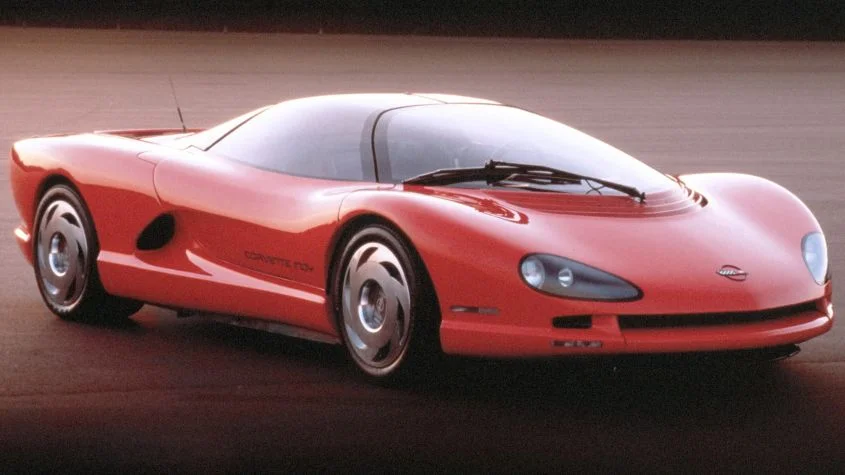
GM's Corvette Indy: A Glimpse Into the Future
The 1986 Corvette Indy concept by General Motors illustrated a different approach. Developed rapidly with input from Italian specialists Cecomp, it showcased innovations like four-wheel steering and advanced suspension systems. While the Indy represented a forward-looking vision for technology, the actual mid-engine Corvette would not materialize until several decades later. It’s paradoxical that GM was ahead of the curve with such a concept only to leave it unrealized for years, which raises questions about how corporate decision-making can stymie progress.
Alien: A Peak ’80s Fantasy
Wrapping up the era's unforgettable designs is the Alien concept created by the Sussex-based IAD. Aimed at producing something even more audacious than a Lamborghini Countach, the Alien’s bubble-roof and dramatic silhouette achieved precisely that. The concept's feature allowing for powertrain swaps by unplugging the back section underscored its sci-fi ethos. Although never intended for production, its sheer creativity encapsulated the spirit of automotive design in the 1980s, where ambition often outweighed market realities. This concept serves as a lens through which we can view the aspirations of an era unafraid to stretch the limits of possibility.
The Legacy of 1980s Supercar Concepts
These concepts, with their bold designs and technological pursuits, reflect a lost chapter in automotive history—a glimpse of what could have been if the right conditions had aligned. As we look back, they remind us of a time when the ambition of supercar design often outweighed the realities of the marketplace. For enthusiasts, there's an undeniable allure to these long-forgotten dreams. They highlight the tension between innovation and practicality, illustrating how visionary designs often crash against the barriers of economic feasibility and consumer acceptance.
Future Implications and Significance
The impact of these ambitious concepts from the 1980s continues to resonate today. Automakers are still grappling with the balance of introducing high-performance vehicles while catering to consumer expectations for practicality and sustainability. If you’re working in this space, the lessons learned from these historical models might inform your approach to product development and innovation. The challenge remains: how to capture the spirit of audacity these brands exemplified while ensuring market viability is equally critical now as it was back then.

Discussion
Sign in to join the discussion.