Honda is pioneering a wireless charging road technology aimed at enhancing the efficiency of electric vehicles, set for demonstration in 2027.
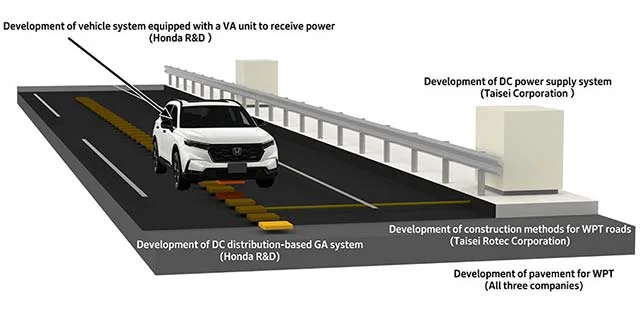
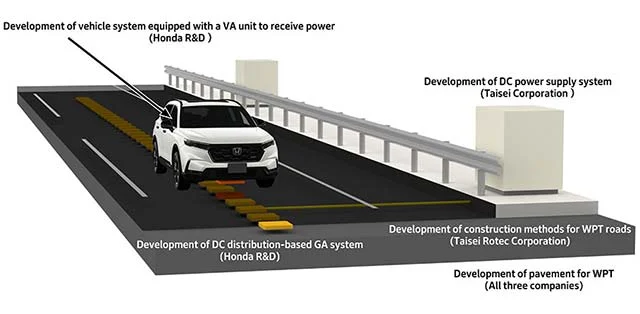
Honda is making significant strides towards a future where electric vehicles (EVs) can charge on the go, collaborating with Taisei Corporation and Taisei Rotec Corporation to develop a wireless charging technology that maintains battery levels while driving. This ambitious project is set to enter the demonstration phase in Japan during the 2027 fiscal year, officially starting on April 1, 2027.
Dynamic Wireless Power Transfer: The Technology Behind It
Honda has been exploring Dynamic Wireless Power Transfer (DWPT) since 2021, focusing on magnetic coupling technology that enables real-time electricity transfer. The setup consists of transmitter coils installed beneath road surfaces, creating a magnetic field that charges vehicles equipped with corresponding receiving units as they pass over. This technology represents a shift in how we think about EV charging, allowing for on-the-go energy replenishment rather than stationary power inputs.
This collaboration brings together Honda's expertise in high-power-density transmitter and receiver technology, Taisei's advancements in high-response DC power supply systems, and Taisei Rotec's capabilities in embedding charging infrastructure within road surfaces. Together, they're developing a comprehensive system that caters to everything from personal EVs to heavy-duty commercial vehicles. This partnership is not just a merging of technologies; it's a strategic move to integrate various facets of charging infrastructure into our existing transportation networks.
Targeting Heavy-Duty Electric Vehicles
A key highlight of this initiative is its emphasis on heavy commercial vehicles, which face unique challenges regarding battery capacity and charging times. These vehicles, integral to logistics and freight moving, often have to navigate routes where charging stations are sparse. The importance of wireless charging for such vehicles can't be understated; it addresses operational delays and enhances the overall efficiency of transport networks. To ensure the wireless charging infrastructure can support vehicles weighing up to 20 tons, rigorous testing is underway to assess durability and functionality at high speeds.
The road system comprises a few core components: a DC power supply integrated into the ground, assembly units that house the power transmitters, and vehicle-mounted power receivers. Honda has designed an efficient DWPT ground assembly unit that combines an inverter and coil, allowing stable and responsive high-power wireless energy transfer. This integrated technology also simplifies the necessary electrical infrastructure within the road, reducing the need for extensive overhead installations which can be both costly and visually disruptive.
Preparation for Real-World Testing
An important milestone will be reached at the Future Technology Field for Taisei Group/Tamura, referred to as T-FIELD/TAMRA, where a dedicated test roadway is scheduled to be constructed starting in late 2026. There, Honda and its partners will conduct durability tests to simulate approximately one million wheel loads, while also assessing the wireless power transfer capability and mitigating risks related to electromagnetic field leakage. This early testing phase is fundamental, as it allows researchers to identify potential problems that could arise when the system is exposed to daily traffic conditions.
Further development will focus on practical applications, with power transfer testing aiming for output levels of up to 150 kW, primarily to accommodate the needs of large commercial vehicles. Ensuring reliable charging while moving at speed is paramount; the objective is not just to charge vehicles, but to do so efficiently and quickly, as every second on the road matters for commercial operations.
Future Road Demonstrations and Industry Impact
From 2027 onward, Honda and its partners plan to extend their testing beyond controlled environments to public roads. They intend to be part of the Tateyama Project, collaborating with East Nippon Expressway Company on dynamic wireless power transfer demonstrations on the Tateyama Expressway in Chiba, Japan. This step forward signifies a shift from theoretical concepts to practical applications, which could potentially set the standard for future EV infrastructure.
If successful, this wireless charging approach could significantly reshape EV development and operation. Instead of depending solely on large batteries and fixed charging stations, vehicles could receive energy during standard trips. This could substantially benefit electric trucks, which require significant electrical capacity for long-distance travel and often face operational delays due to charging downtimes. Think about it: electric buses and delivery trucks won’t have to stop for charging anymore, which translates directly into increased productivity and efficiency.
Implications and Future Outlook
The implications of Honda's initiative extend beyond mere technical innovation. If vehicles can charge while driving, it could alter the entire approach to EV design, production, and ownership. The conversation about battery sizes might pivot from "How much range do we need?" to "How much range can we optimize?" If vehicles rely heavily on dynamic charging, manufacturers might focus more on efficiency and energy management, rather than just battery size.
For consumers, this means reduced range anxiety and possibly lower costs associated with EV ownership. Charging infrastructure will not only become less of a concern but also might evolve into a public utility model that integrates energy into our daily transportation, making EVs more attractive to a broader audience. It's a far-off goal for now, but the groundwork being laid by Honda and its collaborators suggests a future where we might see an entirely new ecosystem of transportation powered by dynamic energy transfer.
While Honda's wireless charging road technology is still in its developmental stage, the anticipated public demonstrations in 2027 are crucial for incorporating dynamic charging into the future transportation framework. What this means for you, whether you're an industry player or a consumer, is that you should keep your eyes on this project—it’s shaping up to have lasting impacts on the way we think about traveling in electric vehicles.
Discussion
Sign in to join the discussion.