The upcoming Audi RS Q5 aims to challenge competitors like the BMW X3 M and Alfa Romeo Stelvio Quadrifoglio with impressive specs and technology.
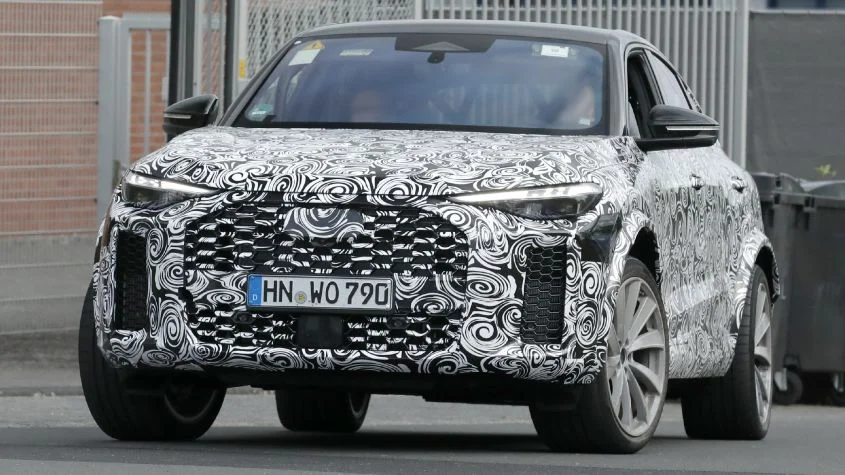
Audi is poised to introduce the RS Q5, a super SUV designed to fill the gap in a market previously occupied by the now-discontinued BMW X3 M. Its arrival is timely, as the aging Alfa Romeo Stelvio Quadrifoglio currently serves as the main challenger in this niche. Recent spy shots reveal a sportback prototype showcasing typical Audi Sport features in a near-final form.
Design and Aesthetic Features
The design of the RS Q5 prototype is proving to be an intriguing mix of aggressive styling and practical performance enhancements. It sports modifications such as makeshift wheel arch extensions to accommodate wider wheels. These changes not only enhance its visual appeal but also hint at the vehicle’s performance capabilities. The prototype retains the body structure of a standard SQ5 Sportback, yet its front end boldly demonstrates a more aggressive RS5-inspired aesthetic. The inclusion of large vertical vents positioned near the headlights suggests an intent to channel airflow for improved cooling during high-performance driving, indicating Audi's commitment to performance.
Behind these honeycomb grilles, we find heat exchangers and dedicated brake cooling ducts—a direct nod to the serious performance intentions underlying this model's design. These elements are not merely decorative; they play a vital role in enhancing the SUV’s overall efficiency and performance under stress.
At the rear, the SUV flaunts pronounced oval exhaust outlets, signaling its performance pedigree. However, the prototype raises questions about its near-production status, particularly in terms of its bumper design, which lacks the integrated exhaust outlets typical of models like the RS5 or the upcoming RS6. There's also a noticeable rear spoiler that not only contributes to downforce but also visually aligns with Audi’s sporty ethos. Though interior details remain scant, a peek through the windscreen reveals the presence of sport-oriented Recaro seats, hinting at the driver-focused environment awaiting inside.
Powertrain Considerations
Under the hood, expect the RS Q5 to borrow significant elements from the RS5's powertrain. This includes the 2.9-liter twin-turbo V6 engine paired with an electric motor, typically producing around 630 horsepower and 603 lb-ft of torque. However, the actual performance could still vary. The anticipated increased weight and altered aerodynamics of the RS Q5 compared to its coupe sibling could lead to compromises in performance metrics—something that enthusiasts are bound to discuss.
The prototype doesn't sport high-voltage warning labels, which strongly suggests it is indeed a hybrid model, aligning with Audi's recent push into electrification. The dual fuel flap system—one for regular refueling and another on the left side for charging—serves as a clear indicator that this Q5 will feature plug-in hybrid technology. Such a setup allows for a blend of traditional combustion power coupled with the efficiency benefits of electric driving, but what this ultimately means for the driving experience remains to be seen.
Dynamic Performance Features
When it comes to dynamic performance, the RS Q5 is expected to incorporate advanced suspension technology designed to deliver responsive handling and ride comfort. Features such as twin-valve dampers are anticipated, allowing for distinct compression and rebound adjustments that mirror those found in the RS5. Furthermore, the five-link rear suspension setup is likely to enhance handling in a way that ensures the driver feels connected to the road—a vital aspect for any performance-oriented vehicle.
Notably, the RS Q5 may inherit the RS5's electromechanical torque-vectoring rear differential, capable of directing torque variances between rear wheels with impressive quickness—up to 2000nm in as little as 15 milliseconds. This precision engineering is designed to facilitate dynamic driving experiences and includes a drift mode aimed at maximizing rear-wheel performance. (And this is the part most people overlook: the way torque vectoring can transform the feel of a vehicle around corners.)
However, uncertainty surrounds whether a rear-wheel steering system will make the cut. Observations of the prototype suggest an outward angle of the rear wheels when the front wheels are turned, hinting that this highly responsive feature might be under consideration to enhance agility. It's a feature that'll attract attention, especially among enthusiasts who prioritize nimbleness in a performance-oriented SUV.
Market Position and Competition
The RS Q5 is positioned to carve out its identity among competitive offerings in the super SUV segment. While the RS5 has received a mixed response—appreciated for its technical prowess yet critiqued for leaning more towards grand touring than hardcore sports performance—the RS Q5 is anticipated to adopt a distinctly sporty persona suitable for fast SUV dynamics. It could be the shot in the arm that Audi needs to compete aggressively in this segment.
This prototype, still in its development phases, is expected to make its public debut next year. Upon its arrival, the RS Q5 will square off against notable competitors like the Alfa Romeo Stelvio Quadrifoglio, which has its own passionate following, for supremacy in the compact super SUV space. Rivals like the Mercedes-AMG GLC 53 and the BMW X3 M50 also serve as formidable adversaries, offering more approachable performance and price points that widen the market's appeal.
Implications and Future Outlook
The arrival of the RS Q5 not only signifies Audi's intention to enhance its performance SUV lineup but may also reinvigorate competition in this exciting segment. With automakers increasingly focusing on electrification while retaining performance capabilities, the RS Q5’s hybrid powertrain could set the stage for how future SUVs are designed. If you're working in this space, the implications of a successful launch could lead to shifts in consumer preferences and industry standards.
As the performance SUV market continues to evolve, with manufacturers pushing boundaries, the RS Q5 aims to solidify Audi's place at the forefront. How it measures up against its competition will likely influence not just player strategies but also consumer choices in an increasingly crowded segment.
Discussion
Sign in to join the discussion.