FAW and Shell's latest immersion-cooled battery tech boosts electric truck efficiency, durability, and safety, targeting commercial applications.
Enhancing Electric Truck Battery Performance
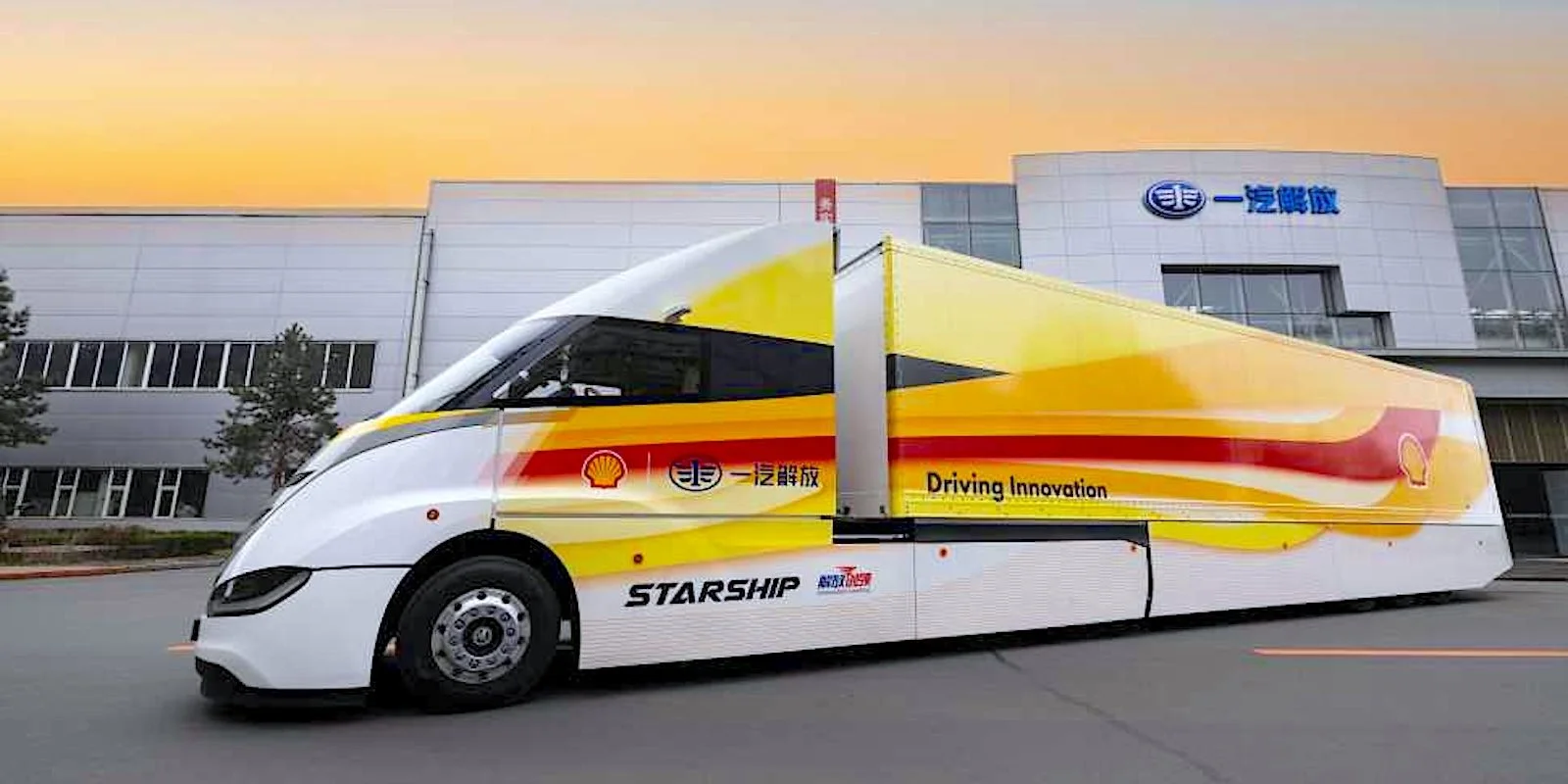
The Starship 3.0 concept vehicle is at the forefront of battery technology, integrating an innovative immersion-cooling system designed to tackle heat management, optimize performance range, and extend the lifespan of electric semi-truck batteries. In an industry that’s growing more competitive and demanding, the introduction of a battery technology capable of addressing these challenges is an indication of where the future of electric transportation might be heading.
Collaboration Between Industry Leaders
This battery system is a result of a strategic partnership between FAW, a leading Chinese truck manufacturer, and Shell’s chemical division. Unlike traditional cooling methods that often rely on air cooling or liquid cooling using water or antifreeze, this system envelops the battery cells in a non-conductive immersion fluid. This transition to immersion cooling means improved thermal management, which is crucial given the escalating demands on electric vehicle (EV) batteries, particularly in commercial applications.
Besides just performance, the choice of materials and methodology in these systems heavily influences the efficiency and longevity of batteries. Standard cooling practices tend to struggle under the heat generated during prolonged use, leading to thermal runaway situations that can compromise battery integrity. What you see in this FAW and Shell collaboration is a more proactive approach to thermal management, where the liquid cooling method provides consistent temperature regulation, drastically reducing the risk of overheating. That could mean longer-lasting vehicles and improved safety for drivers.
Proven Under Real-World Conditions
The immersion-cooled battery pack has completed necessary industry-standard testing for on-road certification and is undergoing validation by FAW under rigorous commercial vehicle conditions, which include high-power charging and rapid energy discharge scenarios. Ensuring the technology holds up in real-world situations is essential; electric trucks must perform reliably in various environments, from urban deliveries to long-haul treks across highways.
This stage of testing is critical not just for consumer confidence but also for regulatory approvals that often accompany new vehicle technologies. Achieving validation means that the technology isn’t just promising on paper; it has shown its mettle under the pressures of actual commercial use. Companies looking to invest in electric fleets will be keen to learn about how these systems perform when pushing them to their limits, like during quick charging sessions that put immense strain on battery components.
As Wang Jianyu, President of Commercial Vehicle Development at FAW, emphasizes, achieving effective battery thermal management becomes vital as the demand for commercial vehicles grows. His remarks also highlight how the integration of FAW’s engineering expertise with Shell’s advanced cooling technology creates a more compelling case for the advancement of hybrid commercial vehicle performance. It’s a blend of knowledge from the battery lifecycle to operational logistics, which could unlock even further efficiencies.
Impressive Performance Metrics
Early testing results are promising. FAW and Shell report that their immersion-cooled batteries have achieved up to a 98% increase in maximum gradability—which measures the truck's ability to handle steep inclines under load—0.8% better energy efficiency, and the potential for up to 32% longer battery life in comparison to conventional systems. If these metrics hold, they’re not just incremental improvements; they could redefine what performance looks like for electric trucks.
You have to consider what a nearly 100% improvement in maximum gradability indicates for logistical operations. Trucks could traverse harder terrains with heavier loads without the efficiency losses typically associated with steep inclines. That’s a significant operational advantage for trucking fleets, especially in regions where geography can be a major hurdle.
But let’s be cautious. While the reported metrics sound great, it’s still important to see what happens under extensive real-world use. Metrics from controlled testing can sometimes paint an overly optimistic picture. Yet, this situation certainly suggests a meaningful shift in how battery performance can evolve, especially in commercial applications where durability and efficiency are paramount.
Showcasing Innovations
The latest developments surrounding the Starship concept and its cutting-edge battery technology will be presented at the upcoming IAA Transportation 2026 trade fair in Hannover, Germany. Both FAW and Shell plan to exhibit the Starship Hybrid and samples of the immersion batteries, highlighting their advancements in truck technology. This showcase presents an ideal opportunity for industry stakeholders to interact with emerging technologies that may soon be part of their fleets.
These types of exhibitions not only serve to inform consumers and industry watchers but also allow companies to gauge potential interest in their offerings. On the flip side, competition will be observing closely; if immersion-cooling technology develops significant traction, expect other players in the space to look for similar advancements or counter-measures of their own. And you'll see that in a sector as competitive as trucking, any advantage—be it in cooling systems or battery efficiency—can quickly set a company apart.
Implications for the Future
The implications of immersion-cooled battery technology extend far beyond one successful prototype. Should these batteries prove their worth in everyday commercial use, it could spark a broader revolution in how electric semi-trucks are designed and deployed. As the industry tackles increased regulations aiming for lower emissions and higher performance, technologies that can handle heat management effectively while delivering reliable ranges are set to become the standard, not just a luxury.
If you’re working in this space, keeping your eye on these advancements could be key. It’s likely we’ll see more emphasis on thermal regulation in battery design across various vehicle models. Early adopters of such technology might find themselves leading the charge as electric trucks gain ground in environmentally conscious regulations targeting lower emissions and higher operational efficiencies.
With continued development and testing, the introduction of immersion-cooled batteries may signal a turning point for electric semi trucks. The potential shift in industry standards could promote a more sustainable future, making electric trucks not just an alternative but a preferred choice for many commercial applications.
SOURCE | IMAGES: Shell; via Freightwaves.

Discussion
Sign in to join the discussion.