The Volkswagen ID. Buzz has set a Guinness World Record for visiting 92 countries during an ambitious 445-day journey without technical issues.
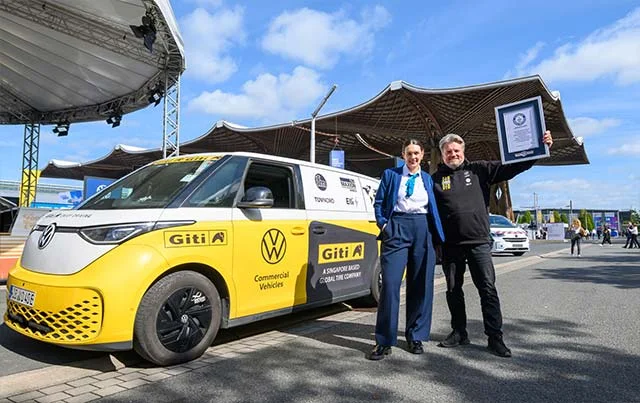
The Volkswagen ID. Buzz has successfully completed a monumental 99,767-kilometer journey through 92 countries across six continents, setting a new Guinness World Record for the “Most countries visited in a continuous journey by a battery powered electric vehicle.” This feat was accomplished by long-distance driver Rainer Zietlow, who spent 445 days on the road without facing any technical breakdowns.
Zietlow embarked on this world tour in the summer of 2025, starting from the Volkswagen Commercial Vehicles Customer Centre in Hannover, the base of the ID. Buzz. The vehicle, a standard production ID. Buzz Pro Long Wheelbase (LWB), was rigorously tested across diverse terrains and climatic conditions, from major urban centers to remote desert landscapes.
Journey Overview: Countries and Conditions
The ambitious route taken during this 445-day excursion showcased key markets across Europe, North and South America, Africa, the Middle East, Southeast Asia, Australia, and China. Zietlow navigated diverse terrains, which included everything from bustling cities to remote outposts. Within this journey, the ID. Buzz underwent over 300 charging cycles and was transported across oceans on 16 occasions via container ships. Impressive isn’t quite the word. The vehicle never experienced a single technical failure, underscoring its reliability amidst various obstacles.
This record-setting journey illustrates the growing global interest in electric vehicles, particularly in areas where traditional vehicle types have dominated. Not only does this showcase Volkswagen's commitment to electric mobility, but it also highlights the capabilities of a modern electric vehicle under challenging conditions. The diversity of the countries visited reveals how tourism can adapt to a future where electric vehicles play a significant role.
Battery Performance and Health
Upon returning to Germany, the ID. Buzz's high-voltage battery received a TÜV Nord certification confirming a 95.75% state of health, despite the extensive mileage accumulated during the trip. This finding is noteworthy, particularly given the multitude of environmental factors—including temperature fluctuations and varying charge levels—the vehicle faced along its journey. Zietlow emphasized this reliability, stating, “I had no technical problems,” which bolsters the argument that well-engineered electric vehicles can withstand long-term wear and tear. It was an undertaking he described as both the longest and most significant project he had taken on in two decades.
Charging Infrastructure: A Mixed Picture
The journey offered valuable insights into the global state of electric vehicle (EV) charging infrastructure. Zietlow characterized the availability of charging stations as highly uneven across different countries; in certain regions of Africa, for example, charging stations were practically nonexistent. This forced the team to access energy at national substations under supervision, highlighting a significant barrier for EV adoption in less developed areas.
In contrast, countries like South Africa, Morocco, and Saudi Arabia have made significant strides in developing their charging networks, demonstrating a willingness to invest in electric mobility. Brazil and Chile also showcased growth in electric mobility. Meanwhile, China stood out with widespread adoption of electric vehicles, indicating a shift in transportation habits. One particularly striking moment occurred in Rwanda, where Zietlow spotted multiple ID. Buzz vans operating as shuttle taxis. This experience underlined the growing potential for electric vehicles to fill gaps in public transportation, offering efficient solutions where traditional means might fall short.
Electric Vehicles vs. Combustion Engines
The trip served to highlight the advantages of electric vehicles over traditional combustion engines. Zietlow outlined various issues faced by combustion vehicles, such as varying diesel quality, which can lead to operational headaches, and the consistent need for maintenance. In stark contrast, the electric drivetrain of the ID. Buzz didn’t encounter the same level of operational difficulties. This is significant—drivers no longer have to worry about fuelling stations running out of their preferred energy source. Still, he acknowledged that thoughtful planning for charging remains essential, particularly in regions with limited infrastructure. While the hurdles for EVs persist, Zietlow concluded that the benefits increasingly outweigh the drawbacks, a sentiment that might resonate particularly well with fleet operators and eco-conscious consumers alike.
ID. Buzz Specifications
The ID. Buzz used for this record-setting journey is the Pro Long Wheelbase version, featuring an 86 kWh battery. Depending on driving conditions, the model can achieve a range of up to 498 kilometers (approximately 309 miles) according to WLTP standards. Not just impressive in terms of range, its DC fast charging capability allows the battery to recharge from 10% to 80% in less than half an hour under optimal conditions. This highlights how far electric vehicle technology has come—enough to sustain long-distance travel without significant inconvenience.
Future Outlook for Electric Mobility
What this means for you if you're working in this space is clear: the global transition to electric vehicles is not just about individual countries implementing change—it's about how infrastructure, consumer behavior, and vehicle reliability will evolve together. This world record stands as a testament to the ID. Buzz's potential for endurance and reliability in the shifting narrative of electric mobility. It signals that production electric vehicles can indeed meet and even exceed the challenges of extensive travel.
However, as the journey shows, achieving widespread adoption requires addressing the uneven state of charging infrastructure and ensuring that electric vehicles can perform reliably in diverse conditions. The need for collaboration among governments, manufacturers, and power companies will be paramount if electric mobility is to be sustainable and accessible across global markets.
Discussion
Sign in to join the discussion.