Milence and Alpitronic are collaborating to enhance high-power charging infrastructure for electric trucks across Europe, addressing critical logistics needs.
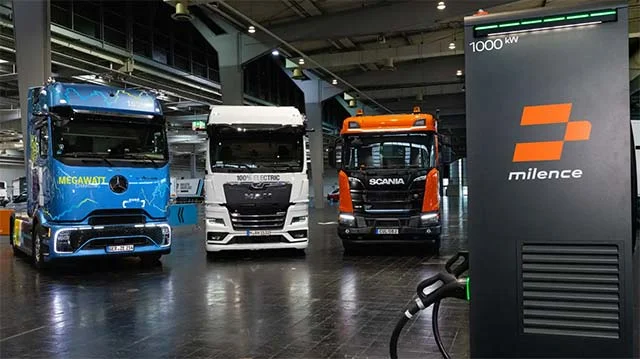
Milence is intensifying its drive to bolster megawatt charging infrastructure for electric trucks throughout Europe, fueled by a recent partnership with charging technology firm Alpitronic. This collaboration, formalized through a Memorandum of Understanding, is aimed at establishing a network of high-power Megawatt Charging System (MCS) stations strategically positioned along key freight corridors across the continent.
As battery-electric trucks are on the cusp of more widespread integration into the long-haul shipping industry, it’s clear that charging efficiency and infrastructure availability are paramount. Milence and Alpitronic’s initiative focuses on enhancing access to high-speed charging along critical transport routes, ensuring that the expanding fleet of heavy-duty electric vehicles in Europe is well-supported.
Powering Up: MCS Charging for Truck Driver Efficiency
Central to this partnership is Alpitronic’s advanced HYC1000 megawatt charging system, which delivers up to 1,000 kW of charging power. At this capability, electric truck batteries can be recharged to about 80% or fully replenished in roughly 30 to 45 minutes, fitting conveniently within the legally mandated rest breaks for drivers on long-haul trips. This synchronization of charging times with mandatory breaks could significantly streamline the operational integration of electric trucks into existing logistics frameworks.
The MCS technology stands apart from conventional CCS truck charging due to its specialized design tailored for high-power requirements in heavy-duty electric vehicles, utilizing a larger connector accommodating the intensified current demands.
Real-World Applications Shine at Industry Events
The potential of this technology was on full display during the IAA Transportation event, where Milence collaborated with major manufacturers like Daimler Truck, MAN Truck & Bus, and Scania to showcase real-time MCS charging. The demonstration involved charging electric commercial vehicles at high power, emphasizing the practicality of megawatt charging in day-to-day long-haul operations.
The setup incorporated Alpitronic's HYC1000 alongside a Pixii PowerBase XLP battery energy storage unit, which offers up to 1 MW of power and boasts a storage capacity of 2 MWh. This combination provides a buffer against grid limitations, enhancing efficiency in locations with restricted electric capacity during truck charging.
Additionally, the live display facilitated interoperability enhancements, ensuring alignment between various manufacturers' vehicles and charging infrastructure—a vital step towards the broader deployment of MCS technology in commercial settings.
Pioneering a Comprehensive Charging Ecosystem in Europe
Founded in 2022, Milence is a joint venture that includes major players like Daimler Truck, the Traton Group (comprising MAN and Scania), and the Volvo Group. Their mission is to establish a network of publicly accessible charging hubs for heavy-duty electric vehicles across Europe. Already, 40 hubs are operational across nine markets, with a target of expanding to 70 hubs by the end of 2027, over half of which will utilize MCS technology.
This growth strategy is particularly crucial along major freight routes, as reliable access to high-power charging is necessary for electric trucks to compete effectively with conventional diesel models.
Beyond Power: Enhancing Operations and Reliability
The Milence-Alpitronic partnership will also prioritize digital integration and the operational management of charging stations. The companies are set to collaborate on technologies aimed at remote monitoring, diagnostics, and maintenance to elevate both the availability and efficiency of charging infrastructure. For fleet managers, having dependable charging access can prove just as critical as the peak charging capabilities themselves. If a high-powered charger is offline or frequently needs maintenance, it can disrupt essential freight operations.
As such, the emphasis in developing MCS infrastructure is transitioning from merely how quickly trucks can recharge to ensuring that the entire network operates with high reliability and integration.
Advancing Electric Truck Infrastructure Towards Mainstream Adoption
The step-up in MCS-equipped electric trucks and high-power charging stations signals a pivotal moment for battery-electric long-haul transport. Leading manufacturers like MAN, Daimler Truck, and Scania are making strides in advancing electric heavy-duty models, while operators like Milence are expanding the necessary infrastructure to support these developments.
This combination of accelerated charging speeds, the integration of energy storage systems, and the expansion of Europe’s charging network could significantly reduce the major infrastructure barriers hindering long-haul electric truck viability. With a clear path toward 70 operational hubs by 2027, Milence is poised to play a central role in transforming the freight transport sector through megawatt charging.
Discussion
Sign in to join the discussion.