Mercedes-Benz plans U.S. highway hands-free assistance in 2027, alongside route-based urban driving support and a broader sensor and computing setup.
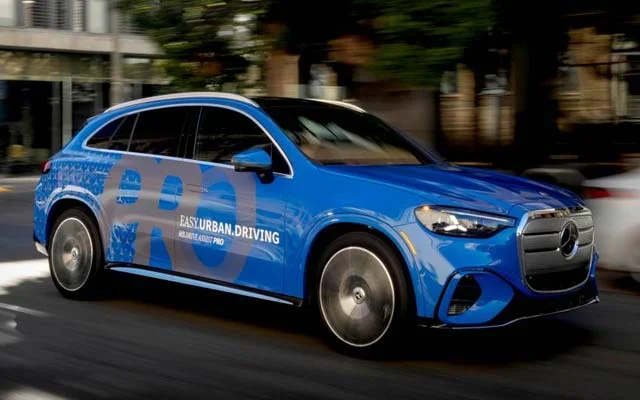
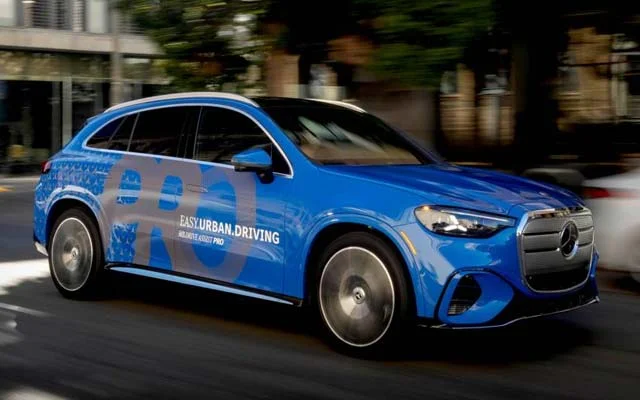
Mercedes-Benz is extending its driver assistance plans from motorway cruising into city journeys, with a U.S. rollout of hands-free highway support set for 2027 and a route-based system intended to assist across urban streets. The schedule places much of the work in 2027, though some features are planned to arrive in Germany earlier and availability will vary by vehicle and market.
The company’s MB.DRIVE expansion brings together Hands-free Assist, Proactive Lane Change Assist and an enhanced MB.DRIVE ASSIST PRO. The distinction between them matters: highway support addresses sustained driving on motorways, while ASSIST PRO is designed to handle a wider sequence of tasks along a navigation route, including driving through city traffic.
Motorway assistance, with drivers still responsible
Hands-free Assist is planned to support driving on motorways at speeds of up to 130 km/h (81 mph), under suitable operating conditions. Mercedes-Benz says the system can continuously assist while adapting to changing traffic. Its practical aim is to ease the workload on longer motorway journeys, where maintaining speed and position can demand sustained attention.
Proactive Lane Change Assist is designed to work alongside that support. When conditions permit, it can initiate and carry out a lane change, such as moving around slower traffic or entering a lane that aligns with an upcoming motorway exit on the navigation route. The system is intended to reduce the number of routine manoeuvres a driver must initiate manually.
That capability comes with a clear limit: drivers remain responsible for the driving task and must stay attentive and ready to take control. Mercedes-Benz describes these functions as driver assistance, not fully autonomous driving. Hands-free operation therefore does not mean a driver can disengage from the road or treat the car as self-driving.
The planned launch sequence begins in Germany, where Hands-free Assist and Proactive Lane Change Assist are due by the end of 2026. The United States is scheduled to receive a nationwide Hands-free Assist rollout during 2027. Mercedes-Benz says availability will expand across passenger cars and vans, with timing dependent on the feature, model and market. Eligible existing vehicles may also receive certain functions through over-the-air updates after rollout starts in their market.
One route, from motorway to city streets
The broader change is MB.DRIVE ASSIST PRO, which Mercedes-Benz plans to offer in Germany and the United States in the first half of 2027. It is designed to assist beyond highway driving, carrying support into more demanding urban situations and connecting those parts of a trip into a point-to-point experience.
With navigation active, the driver can switch on the system using a steering-wheel button. From there, it can assist with tasks such as changing lanes, merging into an appropriate lane, turning at intersections, stopping at traffic lights and moving off when traffic allows. The proposed route-based operation also extends to leaving a motorway and continuing through city streets.
For professional observers, the shift is less about a single hands-free feature than the attempt to make assistance useful across a complete journey. Motorway systems often address relatively structured traffic; city driving brings intersections, pedestrians, cyclists and signals into the picture. Mercedes-Benz’s planned feature set spans both environments, though the company’s stated role for the driver remains active supervision.
The system is intended for different powertrain types, rather than being restricted to electric models. Mercedes-Benz says MB.DRIVE ASSIST PRO is already available in China, where it debuted in the new Mercedes-Benz CLA. The company’s plans for Germany and the U.S. are set for the first half of 2027.
Hardware built for a wider range of road situations
Mercedes-Benz says the expanded assistance system draws on 27 sensing components: 10 cameras, five radar sensors and 12 ultrasonic sensors. A high-performance computer processes their data, with capacity of up to 254 TOPS, or trillion operations per second.
Those figures describe the system’s sensing and computing foundation, rather than proving how it will perform in every driving scenario. The combination is intended to help the vehicle interpret its surroundings and respond to road users and changing conditions. In cities, that means the system must account for a denser mix of traffic, junctions, signals, pedestrians and cyclists than it encounters on a motorway.
The expansion is part of Mercedes-Benz’s wider MB.DRIVE strategy, which is tied to its MB.OS operating system. The company expects selected functions to reach eligible vehicles through software updates, giving some current owners a route to new capabilities once they become available in their market.
Early access starts in December 2026
Before the broader launches, Mercedes-Benz plans to begin an Early Access Programme in December 2026 for selected customers in Germany and the United States. The stated purpose is to gather feedback from everyday driving and use it to refine the systems ahead of wider availability.
In Germany, testing will focus on MB.DRIVE ASSIST PRO in Stuttgart and Munich. In the United States, the initial programme is planned for California and will include both MB.DRIVE ASSIST PRO and Hands-free Assist. That gives Mercedes-Benz an early opportunity to assess its city and motorway features in real-world use before the planned market expansion.
A regional partner strategy
Mercedes-Benz combines its own engineering with technology work involving NVIDIA, Momenta and Wayve. The automaker says it retains responsibility for the overall system architecture, vehicle integration, safety standards and driving experience, while partners contribute expertise in areas including computing, artificial intelligence and automated driving.
NVIDIA is its first strategic partner in automated driving. The companies have worked together on advanced assistance for point-to-point urban driving in Western markets, and Mercedes-Benz says the collaboration is expected to extend to future highly automated driving technologies. In China, it works with Momenta, drawing on the company’s regional experience in AI and automated driving. Mercedes-Benz has been an investor in Momenta since 2017, and the partnership has already produced MB.DRIVE ASSIST PRO for Chinese customers.
A more recent agreement with Wayve is intended to bring that company’s AI Driver technology and embodied AI approach to a new Mercedes-Benz model. The stated aim is to support driving assistance for urban roads and highways. Taken together, the partnerships reflect a market-specific approach, with Mercedes-Benz combining outside technology with its own vehicle systems and integration work.
The next meaningful test is whether the planned assistance can make the transition between motorway and urban driving feel useful while keeping drivers engaged in supervision. Mercedes-Benz’s early access programme, followed by the 2026 and 2027 launches, will put that proposition into customer hands.
Discussion
Sign in to join the discussion.