The revamped MAN eTGX electric truck features significant advancements, including a 720 km range and enhanced charging capabilities, solidifying its position in the market.
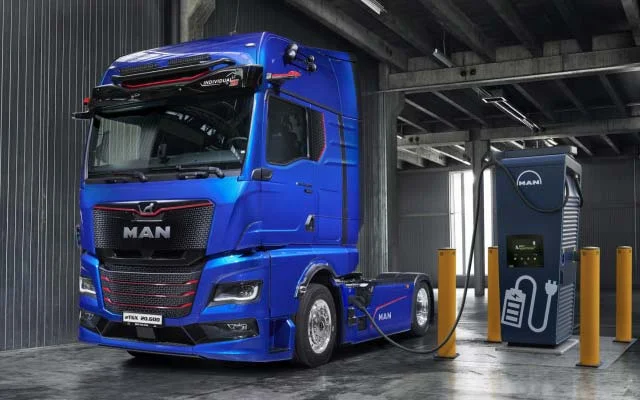
MAN has introduced an advanced iteration of its eTGX electric truck, showcasing enhancements in battery capacity and efficiency at the IAA Transportation event in Hanover. This updated model is designed for long-haul operations and is particularly notable for its extended range and improved aerodynamic features.
Battery Capacity and Range Improvements
The latest eTGX model significantly boosts battery capacity, allowing the vehicle to travel up to an impressive 720 kilometres on a single charge. This places it among the longest-range options for battery-electric trucks in Europe, particularly in an era where range anxiety remains a prominent concern for fleet operators.
The previous version of the eTGX had a maximum battery capacity of 534 kWh, while the new model supports a maximum of 644 kWh gross and 616 kWh net capacity when configured with seven battery packs. Each of these packs boasts a gross capacity of 92 kWh, improving usability and operational efficiency over earlier models. More capacity not only extends range but also increases the utility of the vehicle for various operational needs.
However, this seven-pack configuration is exclusive to the 6×2 tractor setup, which may limit options for fleet managers looking for different configurations. The standard 4×2 tractor can only accommodate six packs, which requires careful consideration of weight distribution and payload requirements for those operators focused on achieving optimal efficiency.
Enhanced Performance Capabilities
Equipped with its 6×2 configuration, the eTGX can achieve an impressive maximum range of 720 km, with MAN asserting that under real-world conditions, drivers should expect around 600 km during typical long-haul operations. This range advantage over competitors, such as the recently unveiled Volvo FH Aero Electric, demonstrates a strong push by MAN to establish leadership in this increasingly competitive space.
The 4×2 variant, while delivering a slightly lower range, still performs admirably, claiming up to 660 km with six battery packs. MAN estimates that in practical conditions, drivers can anticipate over 500 km, which is sufficient for many long-haul scenarios but raises questions about whether it's enough to meet all logistics industry needs.
Aerodynamics and Regenerative Braking Upgrades
Aside from increased battery size, MAN has focused on boosting the eTGX's aerodynamics through its new design. The truck's front end is now extended by 120 mm, optimizing performance while adhering to EU regulations aimed at promoting energy-efficient designs. This change is not just about reducing drag; it also enhances driver visibility, contributing to overall safety—a crucial factor in the trucking industry where visibility issues can lead to accidents.
Regenerative braking has seen a notable upgrade, reportedly providing a 20% increase in energy recovery. Couple this with the battery and aerodynamic enhancements, and you'll find the eTGX poised to extract more range from every kilowatt-hour consumed. This can represent a significant saving for operators, which is often overlooked in discussions about electric vehicle efficiency.
Charging Capabilities and Infrastructure
The eTGX has been equipped to support megawatt charging, featuring an MCS connector capable of handling charging rates up to 750 kW. In contrast, using a conventional CCS connector limits the charging speed to 375 kW. This is more than just a technical specification; it signifies a major step towards making electric trucks viable for demanding logistics operations where downtime must be minimized.
Additional Electric Commercial Vehicles
At the IAA Transportation showcase, MAN also spotlighted its electric TGE vans, developed in collaboration with Swiss company Flux. These electric versions cater to specialized applications, such as emergency services and municipal needs, where conventional electric vans may struggle to meet performance expectations.
Available in two configurations with permissible gross weights of 4.0 and 5.5 tonnes, the TGE vans can carry payloads of up to 2,500 kg and tow as much as 3,500 kg. They're powered by a 119 kWh battery, offering a range of up to 480 km and boasting DC fast charging capabilities that can recharge from 10% to 80% in less than 30 minutes—essential features for urban applications where time is often of the essence.
Looking ahead, MAN's collaboration with Volkswagen Commercial Vehicles on future generations of the TGE line has generated interest, particularly with a new eTGE expected to launch alongside Volkswagen's next e-Crafter targeted for 2028. This partnership could reshape the electric commercial vehicle market, as both brands aim to strengthen their footprint in the rapidly changing landscape.
Implications and Future Outlook
The revamped MAN eTGX not only sets high standards for electric heavy-duty trucks with its impressive 720 km range and 616 kWh of usable battery capacity but also reflects MAN's broader commitment to an electrification strategy that could redefine logistics. This commitment is more than just about technology; it’s about responding to increasing regulatory pressures on carbon emissions and shifting market preferences toward sustainable solutions.
What this means for you, whether you're a fleet manager, an industry analyst, or a policy maker, is that the days of hesitancy regarding electric trucks may be numbered. As technology advances and infrastructure grows, the competitive advantages of trucks like the eTGX will likely accelerate the industry's shift toward electric solutions. In a landscape rife with uncertainty, MAN is positioning itself as a serious contender, paving the way for electric vehicles to become a standard in logistics and heavy transport.
Discussion
Sign in to join the discussion.