More than 850 BP Pulse charging points across 95-plus locations join ChargeHub Passport Hub, expanding access through connected apps and automaker services.
A wider route to BP Pulse chargers
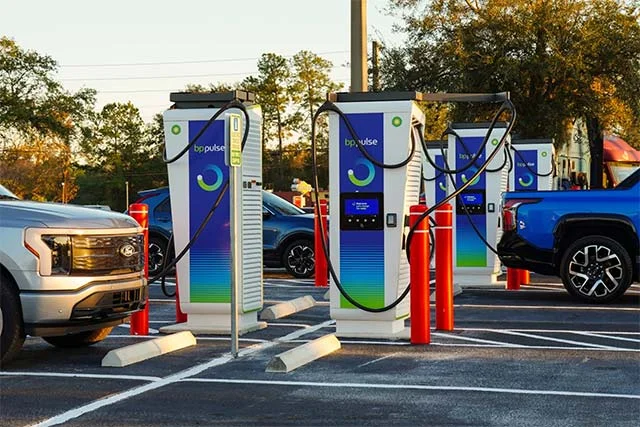
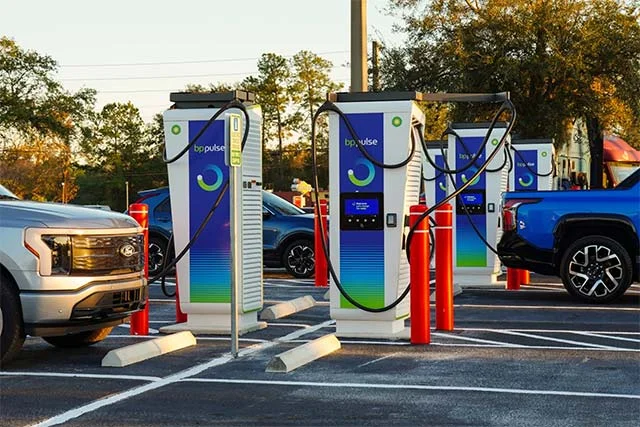
BP Pulse is adding more than 850 charging points at over 95 locations in the United States and Canada to ChargeHub’s Passport Hub. The integration gives the network a route into apps and services drivers already use, addressing a persistent friction point in public charging: finding and paying across networks without juggling accounts. That friction can turn an ordinary charging stop into a small administrative task, especially for drivers who travel beyond the area covered by their preferred provider.
Through the BP Pulse connection, drivers can find participating stations, check availability and pay through the ChargeHub app. Customers using other e-mobility service providers (eMSPs) or automaker platforms connected to Passport Hub may also be able to access the chargers. The announcement doesn’t specify whether every BP Pulse point will appear in every partner service, so the size of the practical change will depend on which locations and functions each service supports.
That distinction matters. A network connection can make more chargers visible without guaranteeing that a driver’s chosen app will show every site, provide the same live information, or support payment at all of them. For now, the announced benefit is broader access through a shared platform, with the details still resting on individual partner coverage.
One integration, multiple access points
Passport Hub links charging networks with third-party mobility platforms and automakers. For BP Pulse, that means a single connection can extend its reach across multiple roaming partners, instead of requiring individual technical integrations with each one. For drivers, the practical benefit depends on which services they use and which stations those services support. The hub approach also gives participating services a common route to charging inventory, which can reduce the need for separate network-by-network arrangements.
That’s a useful structural change, even if it isn’t a guarantee of a uniform customer experience. Public charging involves several steps: locating a station, confirming it’s available, matching the connector to the vehicle, starting a session and paying. A roaming connection can make some of those steps easier, but each one still depends on the information and functions exposed by the app or platform a driver chooses.
ChargeHub already connects dozens of charging operators and mobility providers in the U.S. and Canada, including services associated with Tesla, IONNA and Electrify America. Adding BP Pulse broadens the network’s coverage and gives its partners another charging option to surface to customers. For someone using a connected automaker service, that could mean seeing BP Pulse locations alongside other participating networks in an existing interface.
ChargeHub CEO Simon Ouellette framed the addition as evidence that hub-based roaming is gaining traction in North America. “When a network like bp pulse chooses to connect through Passport Hub, it’s a strong signal that the hub model has become the way roaming gets done in North America,” he said. He added that connected automakers and eMSPs can make BP Pulse chargers available through services their customers already use. That’s the company’s case for the integration; the announcement doesn’t provide usage data showing how often drivers will rely on that access.
Station details still matter
BP Pulse’s U.S. network includes DC fast chargers with different power levels and connectors. Equipment includes 150 kW Tritium units, 180 kW ABB dispensers and 400 kW Alpitronic chargers. CCS1 is the primary connector, while NACS and some CHAdeMO connections are available at certain locations. That range means the network isn’t a single, interchangeable block of hardware: what a driver can use will depend on the equipment at the particular stop and the connector supported by the vehicle.
Drivers can also pay by credit card at stations, so an app isn’t always required to start a session. Plug & Charge is available at selected sites, with support limited by charger availability and vehicle compatibility. Reported prices range from about $0.33 to $0.65 per kWh, depending on the station. Those options give drivers more than one possible route to a session, though they also make it important to check the terms and available features at the specific charger.
Here’s the thing: a station appearing on a map is only the start of a useful charging experience. A driver still needs current information about availability, connector type and price, and an app’s listing can only help if those details are clear and accurate. (And this is the part most people overlook.) Better access to a network doesn’t automatically resolve the uncertainty that comes with choosing a particular site.
What the integration changes for drivers
This is more significant than it looks for drivers who want to manage charging through one familiar service. Each additional network available through a platform can reduce the need to keep track of separate apps and accounts, particularly when a trip crosses areas served by different operators. If you’re working in this space, the measure to watch is whether partner services make the stations easy to find and the session easy to start, rather than simply listing another network.
And yet, the announcement leaves open how consistently the connection will work across Passport Hub’s partners. It doesn’t say whether every participating service will display all 850-plus points, whether availability and payment features will match across apps, or how frequently station details are updated. Those are practical questions for drivers, not minor implementation details: a roaming option is most useful when it can be trusted at the moment a charging stop is needed.
As public fast-charging networks expand across North America, integrations like this can make cross-network trips easier to plan, provided roaming services expose clear, current details. BP Pulse’s addition increases the number of points that may be reachable through ChargeHub and its partners. The next test is whether that expanded access translates into a smoother stop for customers using different vehicles, apps and payment methods. For now, the network connection is a concrete step; its value at the roadside will depend on how well the station-level experience holds up.
The post BP Pulse Adds More Than 850 EV Charging Points to ChargeHub’s North American Network appeared first on Electric Cars Report.



Discussion
Sign in to join the discussion.