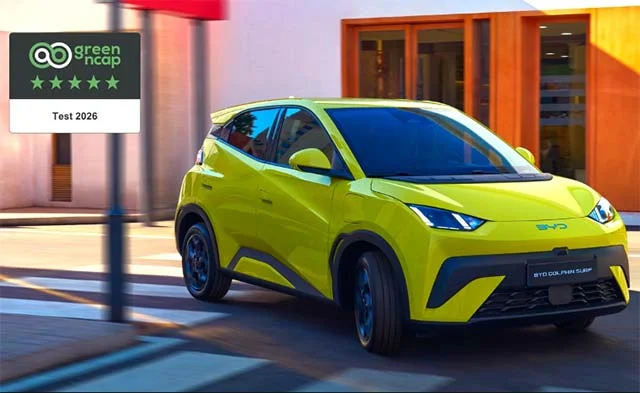
Green NCAP gives the BYD Dolphin Surf five stars and a 96% score, citing low energy use and strong life-cycle results.
A strong environmental score for a small EV
The BYD Dolphin Surf earned five stars and a 96% score in Green NCAP’s environmental assessment. The result puts efficiency and life-cycle emissions at the center of the small electric car’s case for European buyers, alongside its existing safety credentials. That combination matters because buyers often encounter separate ratings for crash protection, energy use and environmental impact; Green NCAP’s assessment brings several of those considerations into one view.
A high score still needs context. It describes the tested car under Green NCAP’s assessment methods, while real-world energy use and emissions depend on conditions such as driving style, temperature, electricity supply and how the vehicle is manufactured. The result is a useful signal of the Dolphin Surf’s strengths, rather than a promise that every owner will see the same efficiency in every trip.
Green NCAP tested the mid-range BYD Dolphin Surf Boost, powered by an 88 PS motor mounted at the front. It weighs less than 1,400 kg and has an official WLTP range of 322 km. BYD lists a 0–100 km/h time of 12.1 seconds and a top speed of 150 km/h. Those figures place the Boost’s appeal in everyday usability and efficiency, rather than rapid acceleration or unusually high top speed.
For a compact electric car, keeping mass and battery size in check can help limit the energy needed to move the vehicle. There’s a trade-off, though: range remains a practical constraint for drivers who regularly make longer journeys. The assessment offers evidence about how the car performs environmentally, but the stated range and test score don’t answer every question about charging access or suitability for an individual buyer.
Efficiency across driving conditions
Energy consumption was a key strength in the assessment, including during highway driving, which can put greater demands on an electric car’s battery. Lower efficiency at sustained speeds can reduce the distance an EV covers between charges, so highway performance gives a useful check on whether an efficiency advantage holds beyond slower urban travel. Green NCAP Technical Manager Dr Aleksandar Damyanov attributed the result to the Dolphin Surf’s compact size, relatively small battery and low energy use. He also pointed to its balanced performance in the organisation’s Driving Experience evaluation.
That assessment connects the car’s physical design with its energy demand: a smaller vehicle generally has less mass to move, while a smaller battery can reduce the amount of material used in production. Neither factor guarantees a low footprint on its own. The result depends on how efficiently the powertrain uses energy and on emissions from manufacturing and electricity supply, which is why the life-cycle analysis adds useful context to a road-efficiency score.
The rating builds on the model’s five-star Euro NCAP crash-test result. The Dolphin Surf has also been named World Urban Car of the Year, adding recognition for safety and urban use to its environmental score. These credentials address different questions, however. A strong crash-test result doesn’t establish low life-cycle emissions, and an environmental rating doesn’t tell buyers how the car will fit their routines.
Life-cycle emissions shape the score
Green NCAP’s Clean Air assessment contributed substantially to the five-star result. The analysis considers more than tailpipe pollution: it includes non-exhaust particles from tyre and brake wear, as well as pollutants tied to energy supply, vehicle production, maintenance and end-of-life recycling. For an electric car, that wider view is especially relevant because the absence of exhaust emissions while driving doesn’t mean the vehicle has no environmental impact.
The car scored 9.9 out of 10 in the Greenhouse Gases category. Its low mass, compact battery and efficient powertrain helped limit emissions, although Green NCAP found that manufacturing in China currently accounts for more than half of the vehicle’s total life-cycle greenhouse gas emissions. That finding complicates a simple “zero-emission car” description: use-phase emissions can be low while production remains a substantial part of the total footprint.
BYD is preparing to start vehicle production in Hungary, which could change the model’s manufacturing footprint for European supply. The assessment doesn’t establish what that change would mean for emissions, so the effect remains an open question. What this means for you: the current score reflects the production circumstances Green NCAP assessed, and future manufacturing changes will matter only if they alter the underlying life-cycle results.
The assessment also noted the Dolphin Surf’s Vehicle-to-Load feature, which can supply up to 3.3 kW to external electrical devices. That capability gives the car a role as a power source for compatible equipment, extending its usefulness beyond transport. It doesn’t change the emissions accounting by itself, but it adds a practical dimension to the model’s feature set (and this is the part most people overlook).
Equipment updates for the range
BYD has made practical changes across the Dolphin Surf lineup. The range now includes a five-seat configuration and a redesigned dashboard. The Comfort trim gets a larger touchscreen, while Boost adds heated front seats and a heated steering wheel. The entry-level Active gains larger alloy wheels.
These updates affect comfort, cabin use and equipment, but the source doesn’t say that they change the environmental score, which was based on the tested Boost. Buyers comparing trims should keep that distinction in mind: a lineup update can improve day-to-day appeal without demonstrating a change in energy use or life-cycle emissions. The assessment is informative for the tested version, while the specifications listed across the range describe a broader product offer.
What the score says about the next step
My read is that the 96% result matters because it pairs low energy consumption with a broader accounting of emissions across the car’s life. This is more significant than it looks for a small EV: efficiency is only one part of the environmental case, and the manufacturing share shows where gains in use can meet limits elsewhere. The reported China production footprint also gives the European manufacturing plan a clear point of comparison, once production begins and its impact can be assessed.
That said, the score shouldn’t be treated as a final verdict on every Dolphin Surf or every use case. The tested car is one trim, and life-cycle results depend in part on production and energy assumptions. If you're working in this space, the useful question is whether the model can retain its efficiency while reducing the production contribution to its footprint. For buyers, the result makes a credible case on environmental performance, with one important caveat still in view: manufacturing accounts for more than half of the assessed life-cycle greenhouse gas emissions. A promising score, with a concrete measure left to watch.


Discussion
Sign in to join the discussion.