BYD’s six-seat Tai 9 folds its steering wheel into the dashboard while parked, pairing a lounge-focused cabin with 536 hp and up to 310 km of electric range.



Turning parked time into cabin space
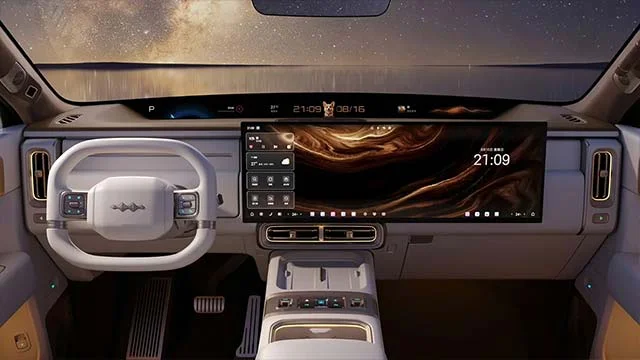
BYD’s Tai 9 treats parked time as part of the cabin experience. Its steering wheel folds into the dashboard, clearing space for the driver to recline, work, eat or relax. The feature signals a broader design priority among Chinese automakers: making large SUVs feel useful and comfortable even when they’re not on the road.
That idea changes the way BYD is asking buyers to judge a premium SUV. A vehicle’s cabin is usually designed around the demands of driving, which means the steering wheel and driver controls occupy a fixed place even when the car is stopped. The Tai 9 proposes that some of this space can serve another purpose when driving ends. It’s a small mechanical change with a clear message about how the brand wants the cabin to be used.
The retractable wheel is fitted to the top-spec Fang Cheng Bao Tai 9 Foldable Smart Cabin, priced at 329,900 yuan, or about $49,400, in China. BYD says the Tai 9 is the first production vehicle to offer this type of folding steering wheel to customers. That claim makes the feature a notable piece of product differentiation, though its value will depend on how often owners want the extra room and whether the transformation feels worthwhile in everyday use.
A cabin that changes shape
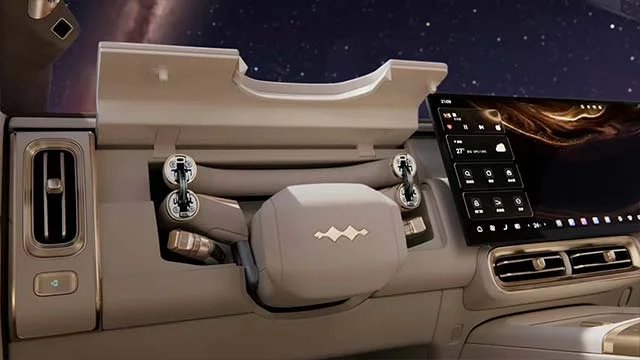
The mechanism depends on steer-by-wire, which sends steering inputs electronically rather than through a conventional mechanical link between the wheel and front wheels. That setup gives the cabin designers room to move the wheel independently of a traditional steering column. The distinction matters: a wheel attached to a conventional steering column cannot simply disappear into the dashboard without addressing the physical connection behind it.
When the SUV is parked, the wheel turns roughly 180 degrees on a concealed hinge and retracts into a dashboard compartment. The operation takes about 10 seconds. A cover then closes over the opening, and a small tray table can fold out in the newly cleared area. The sequence turns a driver’s control point into usable cabin space, although the published description doesn’t establish how frequently owners are likely to use the transformation.
BYD says the driver’s area is about 80% usable with the wheel stowed, and that the mechanism is designed for up to 80,000 cycles. Those claims frame the feature as something intended for repeated use, rather than a show-car flourish. The wheel retracts only while the vehicle is stationary; BYD presents the feature as a way to free up cabin space, not as a hands-free driving system.
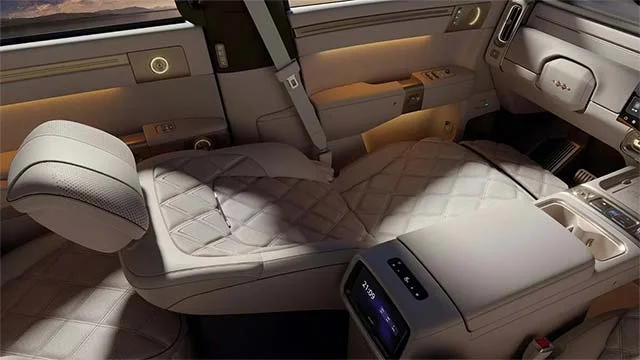
The driver’s seat reclines to 165 degrees, complementing the open layout. Other cabin touches include Nappa leather upholstery and a folding entertainment screen for second-row passengers. Together, they point to a product pitch that extends beyond passenger capacity and road performance. If you’re working in this space, the interesting question is whether these features become useful habits or remain details buyers notice mainly during a showroom demonstration.
Hybrid power and fast charging
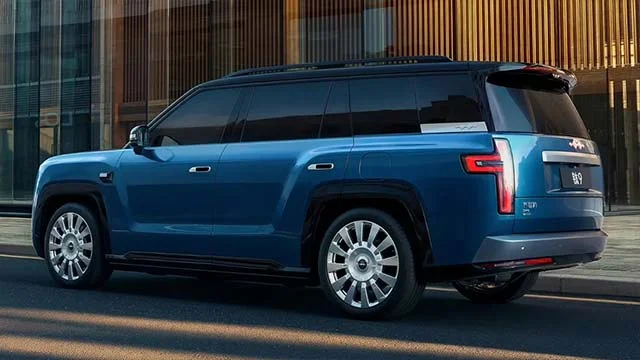
The six-seat Tai 9 uses BYD’s DMS hybrid platform and a 2+2+2 seating layout. It measures 5,270 mm long and has a 3,130 mm wheelbase. Its powertrain combines a 1.5-liter turbocharged gasoline engine with electric motors on both axles, producing 400 kW, or 536 horsepower. These figures describe a large SUV with room for three rows and substantial output, giving the cabin concept a conventional performance story to sit alongside it.
BYD gives a 0-to-100 km/h time of about 4.8 seconds. A 66.48 kWh second-generation Blade battery provides up to 310 km of electric range under the WLTC cycle. The SUV also supports BYD flash charging, with a stated charge from 10% to 97% in around nine minutes. The quoted range is tied to a named test cycle, so it’s best understood as a standardized measure rather than a promise of what every driver will see in ordinary conditions.
The fast charging claim is striking, but it sits within a package that combines gasoline and electric power. That makes the Tai 9’s appeal broader than a single range figure: BYD is presenting electric driving, rapid replenishment and strong acceleration as parts of the same offer. The source figures describe the intended capability; real-world convenience will also depend on how the vehicle is used and on access to compatible charging.
Equipment includes rear-wheel steering, LiDAR sensors and BYD’s God’s Eye B driver-assistance system. The combination puts the Tai 9’s cabin experiment alongside a substantial set of electrified powertrain and driver-assistance features. A long equipment list can help explain a premium positioning, but it doesn’t by itself establish how well each system works in daily driving. That said, the range-topping model is clearly meant to sell a complete technology package, rather than one unusual cabin mechanism in isolation.
Three versions, one folding wheel
In China, the Tai 9 starts at 279,900 yuan (about $41,900). The mid-range version costs 299,900 yuan (about $44,900), while the Foldable Smart Cabin model tops the range at 329,900 yuan. The retractable steering wheel is exclusive to that highest-priced configuration. This gives buyers a defined trade-off: the folding wheel comes as part of the top trim, alongside the broader equipment package associated with that version, rather than as a feature available across the range.
BYD hasn’t announced international availability. For now, the feature’s commercial reach is tied to the Chinese market and the top version of a single model. That limits what can be inferred about how widely the company expects the idea to spread. It’s an unusual feature, and buyers will have to decide whether its parked-cabin use justifies stepping up to the most expensive configuration.
The technology’s arrival in a customer vehicle follows a shift toward electronic steering. China’s updated national steering-system standard took effect on July 1, 2026, allowing steer-by-wire systems that meet redundancy and fail-safe requirements without a traditional mechanical connection. BYD says the motor that operates the folding mechanism was developed for its humanoid robotics program. Here’s the thing: transferring a component from one program to another can help explain how an idea reached production, but it doesn’t tell us on its own how durable or convenient the finished feature will feel to owners.
What the folding wheel signals
The Tai 9’s most striking feature has a practical limit: it only changes the cabin while parked. Its larger significance may be how clearly it frames the next premium SUV contest around the time passengers spend inside the vehicle, as much as the drive itself. The wheel’s movement is the visible part of that argument; the seat, screen and tray table show how the freed space is meant to be used.
This is more significant than it looks, though the significance is about product priorities, not proof that every SUV needs a retractable wheel. Automakers increasingly have reason to make cabins feel flexible across different moments of use, and this design offers one concrete way to do that. And yet, the feature’s appeal rests on a specific routine: the vehicle must be parked, the driver must want to reclaim that space, and the added mechanism must justify its place in the cabin.
For buyers, the useful test will be simple: does the transformed space improve time spent in the vehicle enough to matter after the novelty wears off? BYD has supplied technical claims about operation time and cycle life, but the available information doesn’t answer how owners will use the feature over time. A folding steering wheel makes the Tai 9 easy to distinguish; whether it becomes a lasting selling point is still an open question.
A cabin with room to change. That’s the promise, and the test will be whether the feature earns its space in daily use.

Discussion
Sign in to join the discussion.