Uber riders in parts of northern Munich can join a free autonomous ride pilot, with trained safety operators aboard and trips limited to designated stops.
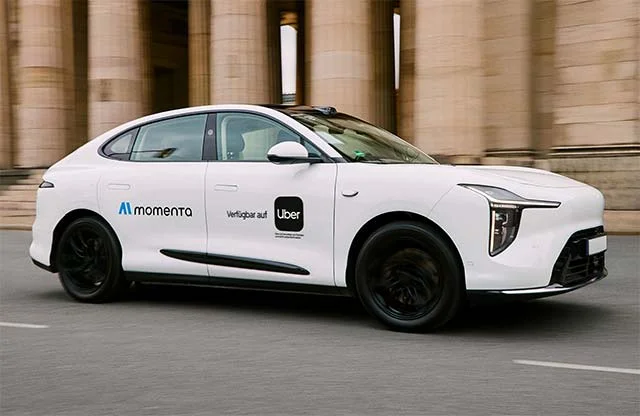
Uber and autonomous driving company Momenta have started a supervised ride pilot in Munich, the first time passengers in Germany can be offered an autonomous trip through the Uber app. The service will test how the technology works with riders on city streets while keeping a trained safety operator in every vehicle. That combination makes the program a public-facing trial, but not a driverless service: a human operator remains part of every journey.
The distinction matters. Autonomous systems can be assessed in controlled tests, but a ride-hailing pilot also puts the booking process, pickup arrangements and passenger expectations into the picture. A vehicle’s ability to navigate is only one part of the experience. The companies will also need to learn whether riders understand the limits of the service and feel comfortable with the supervised format.
Limited access and a defined service area
The pilot covers a designated zone across much of northern Munich, including neighborhoods around Olympic Park. Selected riders who pre-register may be offered an autonomous vehicle when requesting UberX, Uber Electric or Uber Comfort trips within that zone. Journeys will begin and end at designated stops, rather than at any requested address. The boundaries are practical: a fixed operating area and known stopping points can make early rides easier to manage and assess.
That setup also gives riders a narrower version of the convenience they might expect from ordinary ride-hailing. They can request a trip through familiar Uber categories, but an autonomous vehicle may only be available for eligible journeys, and the pickup and drop-off points are constrained. The pilot is testing how the service works within those rules, not whether it can reproduce every feature of a conventional car ride.
Riders can join the waiting list through the Uber app. Access will open in phases, and participants can submit feedback through the platform. All trips are free during the test, which is non-commercial. Free rides may help attract participants, though they don't show how customers would respond to a paid service or what the economics might look like.
Testing under German permits
Momenta is operating under special test permits issued by Germany’s Federal Motor Transport Authority (KBA), with the companies coordinating with local and regional authorities. Uber and Momenta say they plan to extend the operating area to other parts of Munich over time, subject to permit conditions and pilot results. That qualification is central: expansion is an intention, not a timetable or a guarantee.
In a supervised pilot, permissions and operating limits shape what can be learned as much as the technology does. A restricted zone can give operators a clearer setting for observing system behavior, while designated stops reduce the range of pickup situations riders encounter. The trade-off is that success inside those boundaries won't by itself establish how the service performs across the full variety of city trips.
That staged approach makes the Munich program a practical test of both the driving system and the rider experience. Uber Head of Autonomous Mobility Operations Samarth Kejriwal called the launch the company’s first supervised autonomous ride-hailing pilot in Munich, and said it could help inform further expansion in the region. He described a future Uber platform where autonomous vehicles and human-driven cars each have a role. That vision places autonomy within an existing ride-hailing network, rather than presenting it as a wholesale replacement for human drivers.
Real-world driving as a development test
Momenta Robotaxi General Manager Shuo Xie said Germany’s focus on safety provides a foundation for developing autonomous vehicles. The company’s “Physical AI” approach is intended to help vehicles interpret and respond to complex driving conditions; Xie said experience on Munich’s roads will support further development. Each kilometer driven, he added, will contribute to the next stages of the program.
That description points to the value of road experience, but it doesn't reveal how the system handles particular situations or what performance measures the companies will use. In this category, supervised trips typically provide operators with opportunities to observe how technology behaves in ordinary traffic and where human oversight remains useful. The pilot's value will depend on what the companies can learn and how clearly they can explain those findings.
And this is the part most people overlook: the safety operator isn't just a temporary footnote in the passenger experience. Their presence is part of the system being tested, and the pilot's results will need to be understood in that context. A ride completed with a trained person in the vehicle says something about supervised operation; it doesn't, on its own, establish what an unsupervised service could do.
The pilot’s reach is intentionally constrained by its service zone, designated stops and onboard supervision. Its next expansion will depend on what the companies learn on Munich’s streets and on the requirements attached to the test permits.
What the pilot could show next
This is more significant than it looks as a test of how an autonomous service might fit into a familiar app. Riders can encounter the vehicle through Uber's existing trip categories, while the companies can gather feedback on a service with clear limits. If you're working in this space, the key signal won't simply be that rides took place; it'll be whether the operating area and rider experience can expand without the supervision and restrictions changing the nature of the test.
For now, the Munich launch is a bounded experiment. Its progress will be judged by the lessons the companies report, the conditions attached to the permits and whether the service area grows. A useful first step. A commercial model remains untested.
Discussion
Sign in to join the discussion.