MAHLE’s Park & Charge pilot pairs automated parking with 11 kW wireless charging, while a Stuttgart facility prepares for systems rated up to 30 kW.
Parking and charging in one sequence
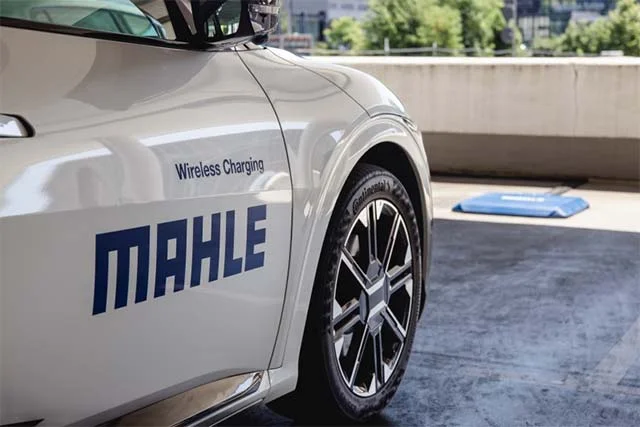
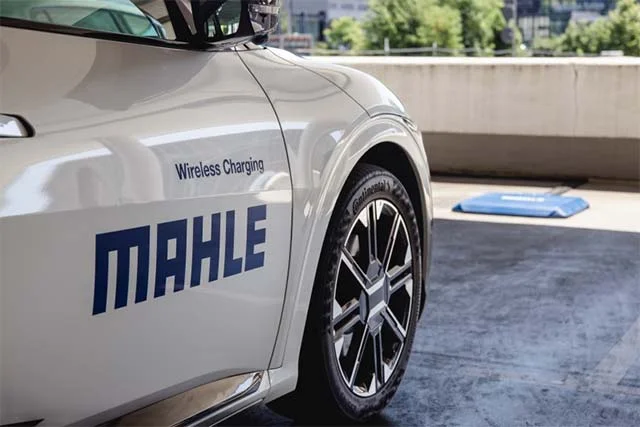
MAHLE’s Park & Charge pilot combines two tasks that still require coordination from an electric vehicle driver: finding a suitable parking space and connecting the car to power. The Stuttgart automotive supplier is developing a system that can guide a vehicle into a wireless charging bay and start charging automatically. Its proposed uses span private cars and commercial fleets, where reducing repeated small tasks could matter as much as adding charging capacity.
The system uses a vehicle’s existing cameras and artificial intelligence algorithms to identify spaces equipped with charging hardware. MAHLE says the car doesn’t need extra sensors for this step, which could simplify integration with vehicles that already have the required cameras. Once it identifies a suitable bay, the Differential Inductive Positioning System (DIPS) helps align the vehicle with a charging pad beneath the parking surface.
That alignment is central to the design. Wireless charging removes the need to handle a cable or plug, but the vehicle and pad still have to be positioned well enough to transfer power. DIPS is intended to make that part of the parking maneuver more precise, joining navigation, positioning and charging into a single sequence. A driver still needs to choose or accept the destination, but the physical connection can happen without a separate plug-in step.
After parking, power transfers inductively, with no cable or plug to handle. The pilot supports charging at up to 11 kW and reaches efficiency above 92% under real-world vehicle conditions, according to MAHLE. Those figures describe the pilot system; they don’t establish how performance will vary across other vehicles, parking layouts or operating conditions. DIPS supplies the positioning accuracy needed for the transfer, and SAE International recognized the system as a global industry standard two years ago.
That combination could be especially relevant for fleets whose vehicles spend predictable stretches parked, including rental, logistics and delivery operations. Automating alignment and charging may reduce routine handling and make it easier to put vehicles back into service after a stop. The tradeoff is practical: the system depends on parking spaces fitted with compatible charging hardware. Convenience for the driver requires coordination at the site.
BMW iX3 validation and test capacity
MAHLE and BMW Group are evaluating the technology in a BMW iX3 against vehicle requirements. The work looks at how charging components fit into current electric vehicle platforms, including coil placement, electromagnetic shielding and safety systems. Those details can shape both the vehicle design and the conditions under which wireless charging can operate, so compatibility has to be established as part of the engineering work rather than assumed from the charging pad alone.
MAHLE has also opened a high-voltage testing facility in Stuttgart, converting a former combustion-engine test cell for electric mobility work. The change reflects a broader engineering need: electric vehicle components must be assessed as systems, under conditions that resemble how vehicles and charging equipment interact. Engineers can test wireless charging in controlled, realistic conditions, including checks for foreign objects in the gap between the vehicle and ground pad and measurements of stray magnetic fields.
Those checks matter because the charging surface sits close to the vehicle and is expected to operate without a driver connecting it by hand. A test program can examine whether the system detects issues in the transfer area and whether shielding and safety components behave as intended. The facility gives engineers a place to probe those questions before a design reaches wider use. A test bench, of course, can’t by itself show how well the system will perform across every real parking site.
The test bench can represent different vehicle architectures, including BMW’s Neue Klasse platform. That gives engineers a way to assess vehicle-side coils, shielding and safety components earlier in development, when design choices may still be adjusted. While the Park & Charge pilot tops out at 11 kW, the facility can test future systems rated up to 30 kW. That capacity points to a broader development program; it doesn’t mean the current pilot charges at that higher rate.
Wireless charging beyond convenience
MAHLE’s system also supports bidirectional energy transfer. Compatible vehicles could eventually send stored electricity back to the grid, enabling vehicle-to-grid applications alongside conventional charging. In principle, this could let parked vehicles play a role in managing energy demand and accommodating renewable power. The pilot’s immediate focus, though, is automated parking and charging, and the source doesn’t establish when or where bidirectional operation would be deployed.
“Wireless charging has the potential to make electric mobility much easier in everyday life,” said Dr. Marco Warth, MAHLE’s Vice President of Corporate Research and Advanced Engineering. He pointed to efficiency, convenience, automation and integration with existing vehicles and charging infrastructure as conditions for wider adoption. That list is demanding: a system can work well in a controlled demonstration and still face friction if cars, pads and operating practices don’t fit together.
What has to work for the pilot to scale
The BMW evaluation and Stuttgart test program will show how well the technology holds up across vehicle designs and safety checks. The results matter because automated charging depends on several pieces working together: the car must recognize an equipped space, align over the pad, and transfer power under the right conditions. That’s a more involved proposition than simply replacing a plug with a ground-mounted charger.
This is more significant than it looks for fleet operators, where repeated stops can turn a small handling task into a persistent operational burden. If you’re working in this space, the key question is whether compatible bays can be placed where vehicles already park for long enough to charge. The equipment’s usefulness will depend on the fit between vehicle schedules, site layouts and charging needs (and this is the part most people overlook).
Here’s the thing: removing the cable simplifies one moment in charging, but it doesn’t remove the need to build and maintain compatible infrastructure. The pilot offers a way to test that tradeoff, while the BMW work and high-voltage facility provide settings for examining vehicle integration and safety. For Park & Charge to move beyond a pilot, automakers and site operators will need compatible cars and charging bays to work as one system.
Promising, but still conditional.

Discussion
Sign in to join the discussion.