Milence proposes pairing truck chargers with renewables, battery storage and energy controls to ease grid constraints as its European network expands.
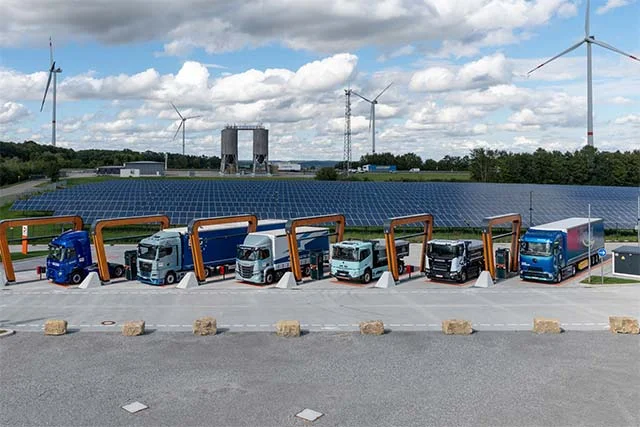
Europe’s electric truck rollout faces a constraint that new chargers alone can’t solve: getting enough power to the right places. Milence argues that coordinated energy hubs, combining charging with renewable generation, batteries and energy management, could help operators make better use of existing grid connections while new network capacity is built.
The proposal comes as the continent has more than 2,500 public charging points for heavy-duty vehicles. Milence, a joint venture involving Daimler Truck, the TRATON GROUP and Volvo Group, operates 42 hubs across nine European markets. It plans to reach 70 locations by the end of 2027, with more than half expected to support the Megawatt Charging System (MCS).
That expansion will depend on where grid capacity is available, but truck depots and public charging hubs need to sit along freight routes and near logistics centers. Those locations don’t always align with spare capacity. In Belgium, France, Germany and the Netherlands, Milence says a connection for a project requiring about 4 megawatts typically takes one to two years to secure. Projects that need grid reinforcement can take longer.
Connection delays put pressure on network plans
The scale of the potential demand makes the connection bottleneck more consequential. Milence estimates that its 14 focus countries could have about 1.1 million electric heavy-duty vehicles by 2040, requiring more than 20 gigawatts of public charging capacity. Building that infrastructure will mean installing high-power chargers along Europe’s main freight corridors, while addressing the time and cost involved in connecting them.
“We are building one of Europe’s largest public charging networks for heavy-duty vehicles, and our ambition is to continue scaling rapidly. But to accelerate the transition to electric road transport, we also need faster access to electricity,” Milence CEO Anja van Niersen said.
Her point is practical: a site’s connection can shape how quickly a charger opens, even when the location makes sense for truck traffic. That makes grid access part of charging network strategy, alongside construction and equipment choices.
Energy hubs coordinate power on site
Milence’s whitepaper, “Making More of the Grid: How Integrated Energy Hubs Can Accelerate Europe’s eHDV Transition,” sets out an approach that combines high-power charging, local renewable generation, battery energy storage systems and intelligent energy management.
In this model, those components operate as a coordinated system. Locally generated electricity can charge batteries when supply is available, then serve trucks during busy periods. Batteries can also reduce peaks in demand from the grid, allowing a hub to deliver substantial charging power without requiring its grid connection to grow by the same amount.
The idea is to get more useful output from available capacity and to bring some sites online sooner. It won’t remove the need to reinforce electricity networks as demand rises. But it could give charging operators more flexibility while that work proceeds, particularly as MCS equipment increases the power requirements at truck stops.
That flexibility depends on how generation, storage, charging and grid access are configured at each site. The whitepaper’s central proposition is that treating those elements as one system can improve use of both local renewable power and the grid connection.
Six policy changes target connection and permitting friction
Milence also calls for changes to connection rules, charges and project approvals. At the European Union level, it wants rules to treat renewable generation, battery storage and charging equipment behind one connection as an integrated system. It also proposes giving projects that demonstrably ease network pressure priority in connection queues and setting network charges to reflect the lower grid impact it attributes to energy hubs.
For national authorities, the company recommends coordinated permitting and standardized contracts. It also wants flexible, shared grid connections to become a standard offering with clear terms, and greater transparency about renewable energy parks so charging operators can identify potential local partners.
Together, the six proposals aim to make energy hub projects easier to plan and connect. Their effect would depend on how grid operators and public authorities put them into practice, as well as whether project developers can demonstrate that shared assets reduce pressure on the network.
Projects in the Netherlands and Germany offer examples
Milence points to its project in Tiel, the Netherlands, and developments in Germany as examples of charging facilities sharing grid connections with other electricity users and renewable energy providers. The company says these arrangements can improve use of existing network infrastructure. Adding batteries and local generation could give those sites more room to respond to changing supply and charging demand.
The examples matter because freight charging sites have fixed geographic demands: they need to serve routes and logistics operations, not simply locate wherever electricity is easiest to obtain. Shared connections and on-site energy assets may give operators more options when a preferred location lacks sufficient capacity on its own.
Van Niersen framed the investment challenge as a parallel effort: “Europe does not need to choose between expanding its electricity grids and accelerating electrification of road transport. We need to do both.”
That is likely to define the next phase of electric freight infrastructure. Grid expansion remains necessary for the scale Milence projects, while better coordination of existing capacity could help charging hubs reach the road sooner. As the company grows its network and prepares for broader MCS deployment, the ability to manage energy at each site will increasingly shape where and how quickly electric trucks can charge.

Discussion
Sign in to join the discussion.