UK BEV registrations climbed 32.7% in October, but forecasts point to a widening gap between sales and the ZEV mandate targets.
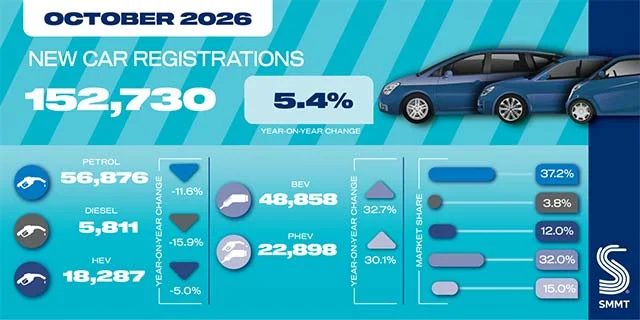
UK electric car sales are growing quickly, but the pace still falls short of the targets set for manufacturers. October brought a 32.7% annual rise in battery electric vehicle (BEV) registrations and a 32% share of new-car sales. Those figures point to substantial momentum, yet growth alone doesn’t show whether the market is advancing fast enough to meet the schedule set by the UK’s Zero Emission Vehicle mandate. The Society of Motor Manufacturers and Traders (SMMT) expects BEVs to miss the targets in the years ahead. That gap is the central tension: more buyers are choosing electric cars, while the required shift is happening faster still.
Plug-in models lead market growth
The wider new-car market grew 5.4% year over year in October, reaching 152,730 registrations. It was the market’s 11th straight month of growth, though the increase was slower than the average for the first 10 months of the year. September’s unusually strong results, linked to the arrival of new number plates, raised the comparison bar for October. That makes the monthly slowdown difficult to read as a sudden change in demand on its own. A single month can reflect timing as well as consumer appetite, so the longer run of results matters more than one comparison.
BEVs took almost one in three registrations, their highest market share of the year. Plug-in hybrids (PHEVs) also advanced, with sales up 30.1% and a 15% share. Together, the two plug-in categories made up 47% of the market, while conventional hybrids brought the share of all electrified vehicles to nearly six in 10. That broad category includes cars with very different charging needs and driving characteristics, so it shouldn’t be read as a direct measure of fully electric adoption. Still, the scale of plug-in sales suggests electric charging is becoming a more familiar part of the new-car market.
Conventional hybrid electric vehicles moved in the other direction: registrations fell 5%, their second monthly decline in a row. That shift may indicate that some buyers are moving toward vehicles they can charge, especially fully electric models, though the monthly figures don’t establish why individual customers made their choices. The distinction matters. A BEV’s appeal depends on the buyer’s ability and willingness to charge, while a PHEV combines a plug-in battery with another power source. The sales mix is changing, but it doesn’t yet tell us how many drivers are ready to make the full move to battery power.
Half a million BEVs registered so far
October lifted year-to-date BEV registrations past 500,000. The UK recorded 503,805 new battery electric cars in the first 10 months, 30.4% more than in the same period a year earlier. That’s a meaningful expansion in volume, and it gives manufacturers a larger base of customers and vehicles on the road. But the mandate is measured against each year’s new registrations, so strong growth from one period doesn’t automatically close the gap to a future target. The trajectory has to keep climbing.
Manufacturers have committed £14.3 billion to UK electric vehicle manufacturing since 2020, according to the SMMT. Buyers can now choose from more than 180 BEV models, with average stated driving range above 300 miles on a full charge. More choice, longer range and more competitive pricing are helping electric cars reach a broader set of customers. These developments address familiar purchase concerns: whether a suitable model is available, how far it can travel, and what it costs to buy. Yet stated range and a wider catalogue don’t answer every practical question, including whether a particular driver can charge conveniently or whether the available price fits their budget.
That distinction helps explain why a growing model range can support sales without guaranteeing that adoption will meet a fixed timetable. Manufacturers can put more options in showrooms, but customers still have to find a car that suits their needs and makes financial sense. Here’s the thing: the headline registration figures describe what buyers have already purchased, while the mandate forecasts require the market to keep changing at a faster pace. The difference between those two measures is where the pressure sits.
Sales growth still trails mandated targets
The SMMT’s outlook puts the tension between rising demand and the mandate in sharp relief. BEVs are forecast to account for 27.2% of new registrations for the full year, below the 33% target. The projected share is 32% in 2027 against a 38% target, then 37.5% in 2028 against a target of 52%—a projected gap of 14.5 percentage points. These forecasts don’t say that electric sales are falling; they show that the expected rate of growth is insufficient to meet the scheduled shares. This is more significant than it looks, because market growth and target compliance can move in different directions at the same time.
Manufacturers have responded with discounts, low- or zero-interest financing, deposit contributions and subsidized charging. Those offers can bring purchase costs down for customers who might otherwise hesitate, and they can help turn a broad choice of models into actual sales. But they also squeeze margins. The SMMT argues that requiring sales at heavy discounts could weaken the UK’s appeal as a market and manufacturing base. That concern reflects a difficult trade-off: incentives may support demand in the near term, while their cost can make the economics of selling and producing vehicles less attractive to manufacturers.
The SMMT also warns that lower new-car prices may affect used EV residual values, potentially making it harder for current owners to afford their next vehicle. That concern connects today’s discounts to the next purchase cycle. If a buyer expects a car’s value to fall sharply, the effective cost of ownership may look less appealing, even when the initial price is reduced. The source presents this as a risk, not a certainty. And yet it’s a relevant one: the health of a new-car market depends partly on whether owners can see a workable path into their next car.
What the gap means for the market
October’s results show that plug-in cars are gaining ground, while the forecasts show how much faster adoption would need to accelerate to meet scheduled targets. For manufacturers, that means balancing model availability and customer incentives against the cost of selling at reduced prices. For buyers, the expanding choice and promotional offers may make an electric car more accessible, but the figures alone can’t tell you whether a particular model will suit your daily use or charging options. If you’re working in this space, the key question is whether demand can keep growing when discounts do less of the work.
The industry’s next test is sustaining demand as model choice grows and incentives carry more of the burden. More models and longer stated ranges can help, but they don’t settle the questions of affordability, charging access or long-term value. Those are the conditions behind the registration totals, and they’ll shape whether rising sales translate into the steeper adoption curve the targets require. For now, the market is expanding; the forecast says it isn’t expanding quickly enough.
More than half a million registrations in the first 10 months is a clear sign of progress. The shortfall against the mandate is just as clear. It’s the distance between those two facts—not the sales rise alone—that will define the debate over the UK’s electric-car transition. (And this is the part most people overlook.) A strong market can still be behind schedule. For all the growth, the next phase has to convert interest into sustained purchases without relying indefinitely on incentives that manufacturers say are costly.
[source: SMMT]
Discussion
Sign in to join the discussion.