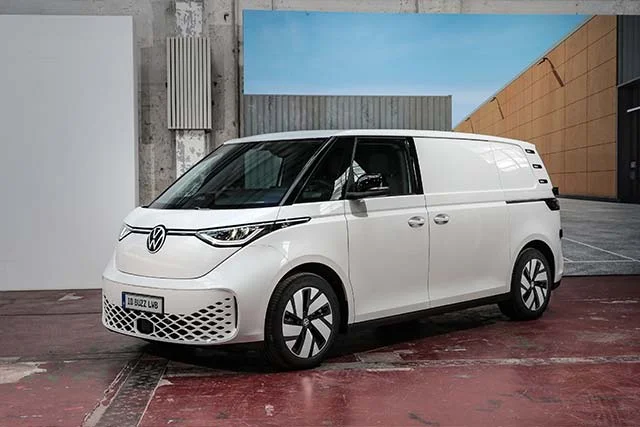
The longer ID. Buzz Cargo adds 0.5 m³ of space, Euro-pallet access through its sliding doors and towing capacity of up to 1,800 kg.
A longer electric van for heavier daily work
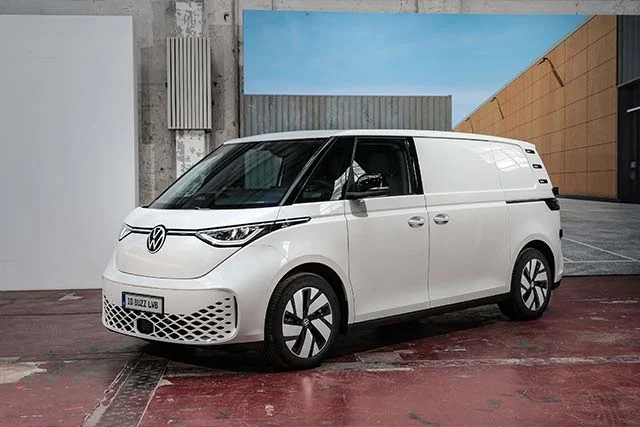
Volkswagen has started building the long-wheelbase ID. Buzz Cargo in Hanover, adding capacity to its electric van range for businesses that need more room without stepping up to a larger vehicle. The change targets a familiar fleet compromise: cargo space, vehicle size and the ability to work in tighter urban settings don’t always line up neatly. Volkswagen’s new version aims to ease that tension by extending the load area while keeping the van within the ID. Buzz Cargo family.
The changes go beyond a longer load bay. The model can carry a Euro pallet through its sliding doors and tow a braked trailer weighing up to 1,800 kg. Those details make the extended version relevant to work that combines equipment, deliveries and occasional towing, though the practical fit will still depend on each operator’s routes and loads.
More room for daily loads
The extended Cargo adds 250 mm to the cargo compartment, bringing its length to 2,458 mm. Volume rises by 0.5 cubic metres to 4.4 m³. That is a measured increase rather than a transformation into a larger class of van, but extra length can matter when equipment is awkward to arrange or when a load needs to stay accessible during a working day.
Volkswagen says Euro-pallet loading through the sliding doors is a first for the model; a second sliding door comes as standard. The access point is as relevant as the added volume. A van can have enough theoretical capacity on paper and still be inconvenient if loading requires repeated repositioning or a restricted approach. Here, the pallet claim gives buyers a more concrete way to assess whether the new body fits their routine.
That combination should matter most to operators whose work involves bulky equipment or palletised goods, but who still need a van suited to urban routes. The added towing capacity broadens its use further: the long-wheelbase version can pull up to 1,800 kg with a braked trailer on gradients of up to 12%. That figure describes a specific towing condition, and buyers will need to match it to the equipment and terrain they actually face.
This is more significant than it looks for businesses that currently split work between a van and a separate towing vehicle. Whether it changes fleet decisions will come down to the complete job: payload, charging access, trailer use and the shape of daily routes.
Two drivetrains, a shared battery
Every version gets an 86 kWh net battery, with buyers choosing rear-wheel drive or 4MOTION all-wheel drive. Rear-wheel drive produces 210 kW (286 PS); the all-wheel-drive option raises output to 250 kW (340 PS). Volkswagen hasn’t provided a range figure in the information here, so the battery and power figures alone don’t answer the operating question fleets are likely to ask first: how the van will fit into their charging and mileage patterns.
The two drivetrain choices point to different priorities. Rear-wheel drive keeps the lineup simpler for buyers who don’t need power sent to all four wheels, while 4MOTION adds output and traction capability. That distinction may matter on particular routes or at certain work sites, but it doesn’t remove the need to assess energy use under real operating conditions.
Volkswagen has also fitted the latest generation of ID. software and an updated infotainment system with an expanded app store. Optional Travel Assist adds automatic traffic-light recognition. One-pedal driving is standard, letting drivers slow the van by easing off the accelerator. These features affect the driving experience and vehicle controls; their day-to-day value will depend on how easily they fit into established fleet routines.
An optional PowerSocket adapter connects to the exterior charging interface to supply electricity to external devices. For tradespeople working away from a fixed outlet, that could make the van useful as a mobile power source as well as a means of transport. (And this is the part most people overlook.) A power outlet can be useful only when its availability and output suit the tools on the job, so the option’s practical value rests on the work being done.
Hanover adds the longer variant to its lines
The new model joins the ID. Buzz family already built at Volkswagen’s Hanover plant, including the standard-wheelbase Cargo and passenger versions with five, six or seven seats. Production required changes to processes for the side panels and sliding doors, but plant head Stefan Depka said the van was integrated with relatively minor modifications and tailored conversion solutions, many completed in-house.
That production detail helps explain how Volkswagen is adding another body configuration to an existing vehicle family. Changes to panels and doors still require adjustments on the line, while in-house conversion work gives the plant a way to accommodate the new specification. The description is Volkswagen’s account of the production transition; it doesn’t by itself establish how quickly output can scale or how the longer version will be distributed among customers.
About 11,000 people work at the facility, which builds Volkswagen Bus models on two production lines. Alongside the ID. Buzz range, Hanover makes the Multivan and has produced the California since summer 2026. Production of the ID. California Cruise camper van is planned for the future. The long-wheelbase Cargo therefore joins a site with several vehicle programmes, making the addition part of a broader mix rather than a standalone factory project.
What the added capacity means for buyers
In Germany, the long-wheelbase ID. Buzz Cargo is available to configure from €48,490. The standard-wheelbase ID. Buzz starts at €40,645. The price difference gives buyers a starting point, but the choice also turns on whether the added length, pallet access, drivetrain option or towing headroom answers a real operating need. A larger specification isn’t automatically the more useful one.
If you’re working in this space, the most practical comparison is between the van’s stated capabilities and the shape of your regular jobs: the objects you load, where you load them, whether you tow, and how you recharge between routes. Volkswagen has made the extended Cargo’s extra capacity easier to describe in concrete terms. The remaining question for each fleet is whether those gains justify the higher entry price and suit its working pattern.
With production now underway, the extended Cargo gives fleet buyers a clearer choice: retain the electric van format while gaining the load length, drivetrain option and towing headroom their work requires. The numbers here are underwhelming if a business expects a wholesale change in vehicle capability; they’re more persuasive when the extra space and access solve a recurring constraint. More room, in other words.

Discussion
Sign in to join the discussion.