Elli’s €1,995 bidirectional charger launches in Germany in December 2026, pairing vehicle-to-grid capability with tariffs and hourly connection payments.
A paid route into vehicle-to-grid charging
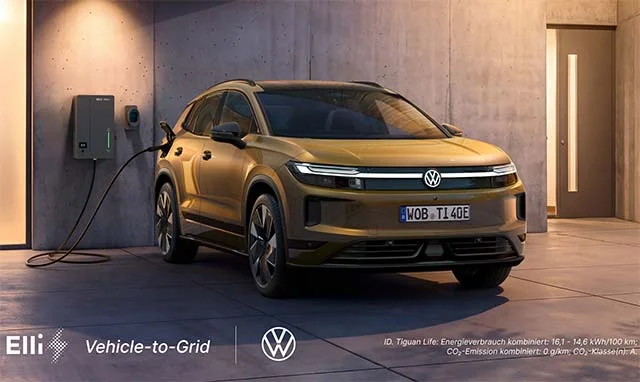
Volkswagen Group’s planned German launch puts a defined price and payment model around vehicle-to-grid charging. Elli, the group’s energy subsidiary, will offer a €1,995 bidirectional DC wallbox alongside electricity tariffs, digital services and installation. The service is scheduled to start in December 2026 for customers of Volkswagen, Volkswagen Commercial Vehicles, CUPRA and Škoda, with other European markets planned for 2027. That gives prospective customers a package to evaluate, though several parts of the offer still depend on their home, vehicle and local installation arrangements.
The commercial proposition hinges on whether drivers can earn from keeping their cars plugged in without compromising the next trip. Elli’s initial model pays €0.24 per eligible connection hour, provided a session lasts at least three hours. Reaching 250 connected hours in a month would bring up to €60, or €720 over the first contract year. Those figures describe a possible return, not a guaranteed one: drivers need enough qualifying time connected, and their plans may not leave the car at home when the system can use it.
That payment is for availability. Elli plans a separate €0.40-per-kWh payment for electricity sent back to the grid, but says it will come later. Volkswagen hasn’t guaranteed any minimum volume of electricity exports, so actual returns will depend on when the vehicle is connected, charging conditions and how the feed-in program is implemented. Here’s the thing: the hourly payment is easier to understand than the export model, but it doesn’t establish how much a household might earn from the battery’s actual use.
Charger, tariffs and installation
The Elli BiDi Charger supports up to 11 kW of charging and discharging and can be installed indoors or outdoors. It supports both 400-volt and 800-volt vehicle architectures and uses the ISO 15118-20 communications standard, which provides a technical basis for compatibility with more electric vehicles. That standard and broad voltage support are useful building blocks, but they don’t mean every vehicle with a matching architecture will work with the service. The model and software requirements still matter.
The €1,995 price includes VAT and shipping, but not a fixed installation cost. Elli will provide an individual quote after a digital technical assessment. Customers must complete that pre-check and receive the quote before ordering the charger. In practice, then, the published price is a starting point for understanding the hardware cost; the total outlay will also depend on what the home assessment finds and what installation requires.
The service combines two Volkswagen Naturstrom tariffs, each with a 12-month term. V2G Flow covers household electricity use and vehicle charging; V2G Return handles payments for electricity discharged from the car battery to the grid. The system’s energy-management technology is being developed with The Mobility House Energy, which manages aggregated vehicle battery capacity for use in electricity markets. Linking charging, household supply and grid exports makes the offer more than a wallbox purchase, but it also means customers are signing up for an energy arrangement with distinct components and terms.
Drivers will set a departure time and required battery level in the Elli BiDi V2G App. The system then manages charging and discharging around those preferences. A compatible smart meter is also required, and Volkswagen advises customers to arrange one early because installation timing depends on the local metering operator. The setup is meant to account for the driver’s next trip, but customers will still need to decide what minimum charge gives them confidence before leaving.
Vehicle support will depend on model and software
Volkswagen says more than one million MEB-based electric vehicles in Europe are technically prepared for bidirectional charging, including about 360,000 in Germany. That figure doesn’t mean every vehicle can use the service at launch: availability depends on each model’s approval and supported software configuration. The distinction matters because a large technically prepared fleet can create a sense of broad access, while the practical customer pool may be narrower at first.
That distinction will matter to prospective customers weighing the charger’s upfront cost against the hourly payments. Vehicle eligibility, a successful home assessment and smart-meter installation all sit between the advertised price and a working V2G setup. If you're working in this space, those dependencies are familiar: connected hardware is only one part of a service that also needs compatible vehicles, home equipment and an energy program that can coordinate them.
The numbers here are underwhelming as a stand-alone case for buying the wallbox, especially because the hourly amount is capped by how many eligible hours a driver can accumulate and the export payment has no stated minimum volume. That doesn’t make the offer irrelevant. It means the value will depend on a household’s charging routine and the final installation quote, rather than the headline payment alone.
V2H follows the German pilot
Elli is also developing a Vehicle-to-Home service for its portfolio in 2027. While V2G sends stored electricity to the public network, V2H would let a household draw on the car battery, potentially storing daytime solar generation for later use. The two services point to different uses for a vehicle battery: one offers grid support, while the other could help households shift when they use stored energy. The details of the planned V2H service haven’t been provided, so its eventual costs and operating rules remain open.
A 12-month Elli pilot with 20 German households recorded about 85,000 charger operating hours and more than 6,500 bidirectional charging and discharging sessions. Those trials are feeding into the company’s next energy products. The figures show that the system has been exercised across a meaningful period of operation, though they don’t by themselves explain how much households earned, how often drivers had to override charging, or how the experience varied between homes. And this is the part most people overlook: an operating session is evidence that a system ran, not proof that the commercial terms will suit every customer.
What the launch will reveal
The December 2026 launch will show how those systems perform as a paid service, where vehicle eligibility and the actual export payment will shape the value for drivers. Elli is moving from pilot activity to a defined retail offer, with a price, tariffs, eligibility limits and a stated schedule for additional markets. That makes the service easier to assess, even as key details—including the installation cost and later export payments—remain dependent on individual circumstances or future implementation.
For drivers, the central question is practical: will the car be connected often enough to earn availability payments while still meeting daily travel needs? The app’s departure-time and battery-level settings address that tension, but they don’t answer whether the combined costs and payments will work for a particular household. A home assessment, compatible vehicle and smart meter are prerequisites, not small-print details. The proof will be in how predictably the system can meet those preferences and deliver the stated payments in ordinary use.
For the wider market, Volkswagen’s offer is a useful test of whether automakers can turn vehicle batteries into an energy service customers will pay to join. The package brings the car, charger, electricity tariffs and grid management under a coordinated offer. That could simplify the customer’s route into bidirectional charging, provided the pieces work together as promised. A defined launch date and payment schedule are a start. The unresolved economics will decide how compelling the service feels after the first contract year.
Discussion
Sign in to join the discussion.