Porsche’s electric 718 Boxster enters final testing with rear-wheel drive, 800-volt battery packaging and a sub-three-second flagship model.
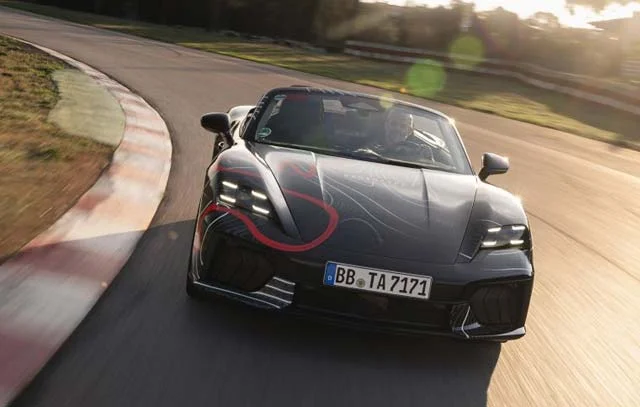
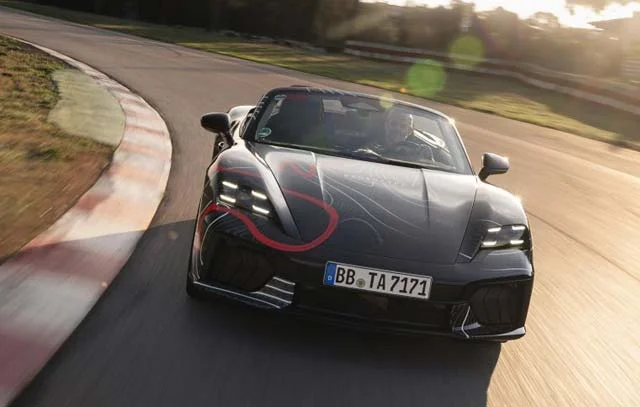
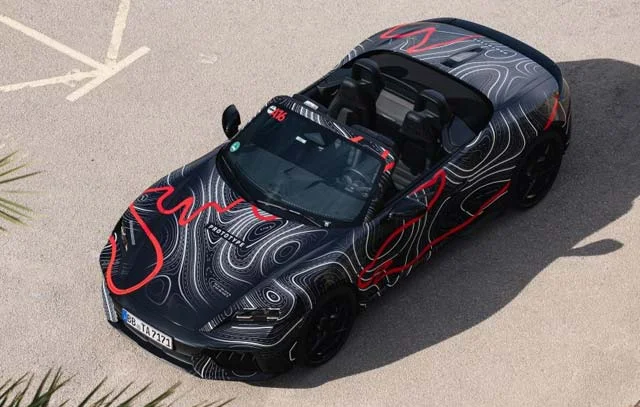
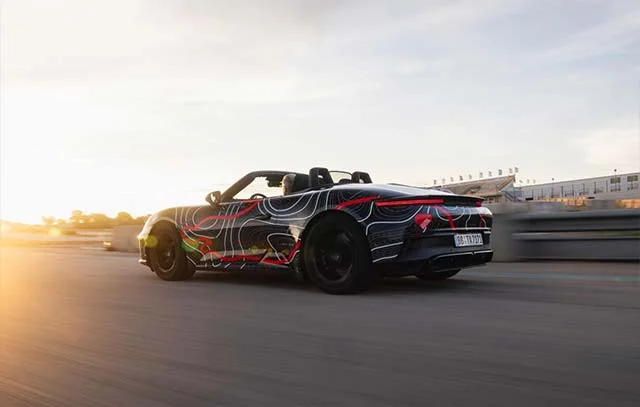
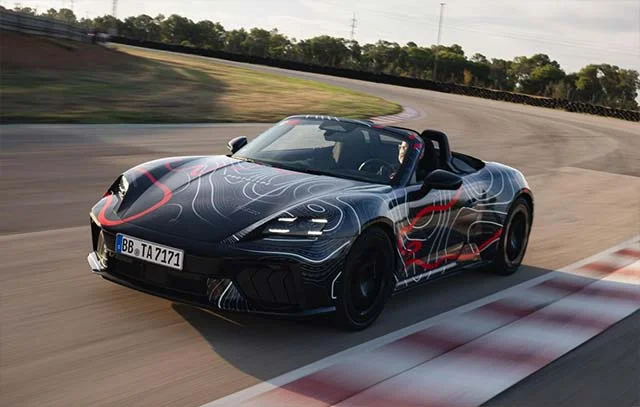
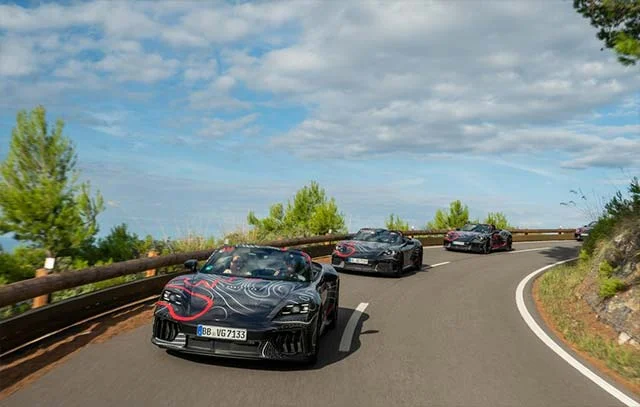
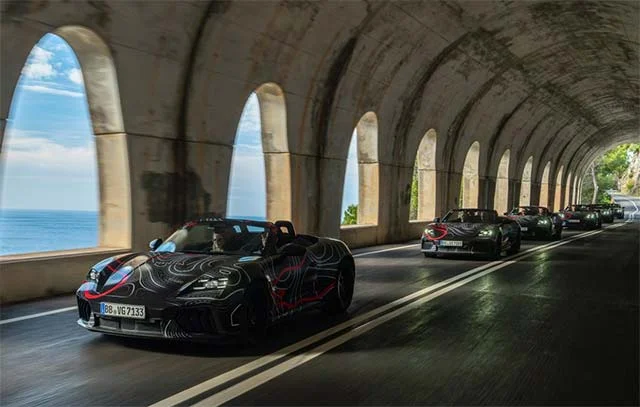
Porsche’s electric 718 Boxster has reached the final phase of development, with a world premiere planned for the first quarter of 2027. The 983-generation roadster has covered roughly four million kilometres during testing, suggesting Porsche is treating its first electric Boxster as a full redesign of the sports-car formula rather than a simple powertrain swap.
Production is scheduled for Porsche’s Stuttgart-Zuffenhausen factory. The central question now is whether the electric model can preserve the low seating position, rear-drive balance and responsive handling that define the Boxster. Porsche’s engineering choices indicate that driving character has taken priority alongside outright performance.
A battery layout built around balance
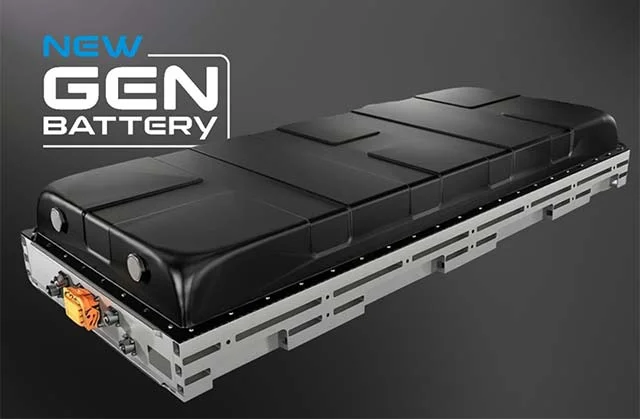
The electric 718 uses Porsche’s E-Core architecture, which places its 800-volt battery behind the seats. That location occupies the space traditionally used by the combustion engine and helps keep the vehicle’s mass close to its centre.
Porsche says the car has a 40:60 weight distribution, with 40 percent of its weight over the front axle and 60 percent over the driven rear axle. Every electric 718 Boxster will use rear-wheel drive. The company is also targeting a curb weight comparable to current 911 Cabriolet models fitted with the T-Hybrid powertrain.
That packaging decision matters more here than it would in a conventional electric sedan. The Boxster’s appeal has always rested on its compact dimensions and mid-engine behavior. Placing the battery behind the occupants gives Porsche a clearer route to retaining those traits while accommodating electric propulsion.
Testing spans severe conditions
Development vehicles have been evaluated in more than 20 countries. Porsche tested them in temperatures ranging from minus 30 degrees Celsius in Sweden to 51 degrees Celsius in Death Valley, California. Engineers also used urban routes in Las Vegas, Los Angeles and Shanghai to assess daily usability, vehicle systems and performance in traffic.
The test programme included five charging standards and routes ranging from 86 metres below sea level to 2,750 metres above it. Those figures point to a development effort focused on operating conditions beyond a controlled performance test.
Early drives from Porsche prototypes have drawn favorable reactions from Car and Driver, The Drive, Autocar and MotorTrend. Reviewers have cited precise steering, stable cornering and a rear-biased balance that feels familiar to drivers of the combustion-powered Boxster.
Some journalists drove a single-motor, rear-wheel-drive prototype with a limited-slip differential. Porsche hasn’t confirmed whether that configuration will match a production model, so the prototype’s drivetrain shouldn’t be treated as a final specification.
911 hardware and a simulated gearbox
The electric roadster borrows several chassis elements from the 911. Its steering system is based on the 911 Carrera GTS, while rear-axle steering will be available for the first time in a 718 Boxster. Porsche is also fitting an electronically controlled PTV+ limited-slip differential, with braking and wheel-and-tyre specifications drawn from the larger sports car.
One of the more distinctive features is the standard E-Shift system. It simulates a seven-speed PDK dual-clutch transmission, with automatic or manual virtual gear changes selected through steering-wheel paddles. The shifting behavior varies with the chosen driving mode.
Porsche has paired the system with a sound profile based on the six-cylinder boxer engine used in the 981-generation Boxster GTS. When E-Shift is disabled, the paddles control three levels of regenerative braking. Porsche says the simulated shifts don’t reduce performance or efficiency, leaving the feature positioned as a driver interface choice rather than a mechanical requirement.
My read is that Porsche is using E-Shift to address a specific weakness of electric sports cars: their speed can be impressive while their interaction feels remote. Whether the system adds meaningful engagement will depend on its timing and calibration, details that remain unavailable.
Performance figures remain limited
The flagship electric 718 Boxster will be the most powerful model in the series, according to Porsche. It will reach 100 km/h from rest in less than three seconds and exceed 250 km/h at the top end.
Those are the only headline performance figures confirmed so far. Porsche hasn’t released power output, battery capacity, driving range or charging times. Pricing and the full model lineup are also still undisclosed.
That missing data leaves the car’s practical position unresolved. A sports car can deliver exceptional acceleration and still face compromises in range, charging frequency or mass. The E-Core layout and reported handling suggest Porsche understands that distinction, but production specifications will determine how convincing the package becomes.
Production follows a demanding transition
The electric Boxster project has faced supply chain difficulties and uncertainty around the future of the electric 718 platform. Porsche’s latest update confirms that the programme has continued into its final development stage, with the 2027 premiere still scheduled.
The car’s technical recipe is clear: an 800-volt battery behind the seats, rear-wheel drive, a 40:60 weight split, 911-derived chassis systems and an optional-feeling layer of simulated mechanical drama through E-Shift. The unanswered questions are just as significant, particularly range, charging performance, weight and price.
If Porsche can deliver the prototype’s steering and balance in a production car, the electric 718 Boxster may stand out through its responses rather than its acceleration figure. The first quarter of 2027 should reveal whether that promise survives the final step from development vehicle to showroom roadster.
Discussion
Sign in to join the discussion.